Confessor Alexis is a saint of the Catholic Church.
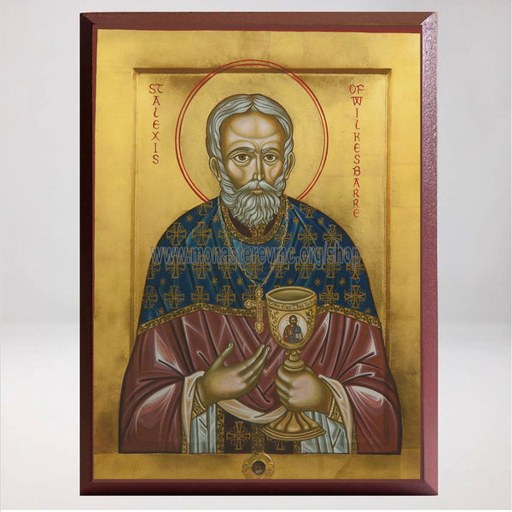
https://monasterevmc.org/en-us/products/st-alexis-toth-st-alexis-toth
License: unknown
Confessor Alexis
Saint- Gender
- male
- Church
- Catholic
Roles & Family
Biography
The title “Confessor Alexis” (also Alexius) does not identify a single historical individual with certainty. In the Latin Church the word “confessor” was long used for any male saint who had not died a martyr, and older liturgical books therefore speak of “Saint Alexis, Confessor.” That designation most often points to the legendary Alexis the Man of God, whose story took shape between late antiquity and the high Middle Ages. The oldest recoverable version is a Syriac narrative set at Edessa, concerning an anonymous “man of God” who lived by alms. A later Greek and then Latin recension transferred the setting to Rome, gave the beggar the name Alexis, and supplied a senatorial father named Euphemianus and a mother named Aglais (or similar forms). In that developed legend the young man left his bride on their wedding night, spent many years as a beggar near the church of Edessa, returned to Rome, and lived unrecognized beneath the stairs of his own family house until death, after which a document revealed his identity. No contemporary chronicle, inscription, or archival record confirms these events, and no year of birth or death can be verified from a reliable historical source. Historians therefore treat the Roman Alexis as a hagiographical construct, however influential the cult became.
That cult is itself a historical fact. By the tenth century the legend was known in the West; a church on the Aventine Hill in Rome, today Santi Bonifacio e Alessio, became the centre of his veneration. Byzantine synaxaria commemorate him on 17 March; the Roman Martyrology kept him on 17 July. Medieval and later devotion made him a patron of beggars, pilgrims, travellers, nurses and belt-makers, and he was invoked against earthquakes, lightning and storms. The Alexian Brothers, a hospital congregation that arose in the Rhineland in the fourteenth century, took their name from him. Because the life is legendary, statements about a spouse, children, or membership in a religious order cannot be controlled by independent evidence; the story itself presents him as an ascetic who abandoned a newly contracted marriage. He was neither Bishop of Rome nor a patriarch.
Several later, historically documented Eastern Christian figures named Alexis have also been honoured as confessors or as non-martyr saints. Saint Alexis, metropolitan of Kiev and all Rus’, died at Moscow on 12 February 1378 and was buried in the Chudov Monastery of the Kremlin. Born into the boyar family of Byakont (his secular name was Eleutherius) in the Moscow region in the 1290s—no exact birth year is securely attested—he was tonsured at the Epiphany Monastery, served as metropolitan from 1354, and acted as a leading counsellor of the Muscovite princes. He was never patriarch; the Moscow patriarchate was established only in 1589. His principal feast days in the Russian Church are 12 February, 20 May (uncovering of relics) and 5 October. Another bearer of a similar title is Saint Alexis Toth, born 18 March 1854 at Kobylnice in what was then the Kingdom of Hungary and died 7 May 1909 at Wilkes-Barre, Pennsylvania. A widowed Greek Catholic priest, he entered the Orthodox Church in 1891 and worked among Carpatho-Russian immigrants in the United States; the Orthodox Church in America glorified him in 1994 as Confessor and Defender of Orthodoxy. His relics rest at Saint Tikhon’s Monastery, South Canaan, Pennsylvania. Still other modern saints—Righteous Alexis Mechev, a married Moscow priest who died in 1923, and Hieroconfessor Alexis (Kabalyuk) of Carpatho-Russia, who died in 1947—have been numbered among the righteous or the confessors of the twentieth century.
In the absence of a Wikidata identifier, a Wikipedia article, a specified feast day, or a particular church calendar, it is not possible to assign a unique, source-verified birth year, birthplace, death place, burial site, patronage list, or act of canonization to “Confessor Alexis.” None of the figures reviewed above was Bishop of Rome or a patriarch or catholicos of an autocephalous Eastern see. The name and the title together belong to a cluster of male saints, one of them legendary and the others historically attested in the second millennium, whose lives and cults must be distinguished rather than conflated. Structured biographical fields that require a single verified identity are therefore left blank.