Confessor Ansovinus is a saint of the Catholic Church (d. 840). Confessor Ansovinus's feast day is celebrated on 13 March. Confessor Ansovinus is the patron saint of Camerino;gardeners;harvests;farmers;protection of crops.
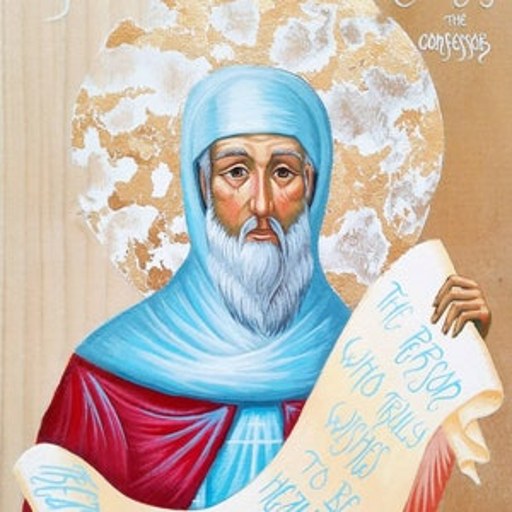
https://etsy.com/listing/1294340881/partly-hand-paintedgilded-st-maximus-the
License: unknown
Confessor Ansovinus
Saint- Life Span
- d. 840
- Feast Day
- 13 March
- Gender
- male
- Church
- Catholic
Places
Roles & Family
Patronage
Camerino;gardeners;harvests;farmers;protection of crops
Biography
Ansovinus (also Ansovino or Ansuinus), commemorated as a confessor, was a ninth-century bishop of Camerino in the Marche of central Italy. He is a figure of local rather than widely documented Carolingian history: contemporary charters and papal registers do not securely fix his birth, consecration, or the precise length of his episcopate, and later legend has attached him to more than one pope and emperor. Tradition, followed by the Roman Martyrology, places his death at Camerino on 13 March, commonly given as the year 840. He is said to have been a native of Camerino itself and to have received his early formation there, almost certainly in a clerical school attached to the cathedral church, before ordination to the priesthood.
Seeking a stricter life, he withdrew for a time as a hermit. Hagiographical accounts locate this retreat at Castel Raimondo near Torcello, though the geography sits awkwardly with a Camerino origin and may reflect later elaboration. The clergy and people of Camerino subsequently called him to the episcopal see. Medieval vitae present him as accepting the office only under pressure from both the Apostolic See and the Frankish court; popular modern notices sometimes name Pope Leo IV and Emperor Louis II, whose dates do not fit a death in 840, while other versions associate him with Louis the Pious. The safer historical statement is that he became bishop of Camerino in the first half of the ninth century and was remembered as an austere pastor rather than as a court prelate.
His cult and later patronage rest above all on stories of charity in time of dearth. He is said to have opened the episcopal stores to the hungry and to have obtained a miraculous increase of grain, a motif common in Italian episcopal hagiography of the early Middle Ages. From these tales he came to be invoked for good harvests, for the protection of fields and gardens, and against famine. Nothing reliable is recorded of a religious order; he appears as a secular clerk who had lived as a hermit and then as a diocesan bishop, and therefore as celibate, without wife or children. He was never Bishop of Rome or patriarch of an Eastern see.
He died at Camerino and was buried in his cathedral city, where his relics have long been kept in the cathedral (today Santa Maria Annunziata). His cult is ancient and essentially local; he belongs to the pre-congregation saints and was not the object of a formal papal canonization or beatification of the later medieval or modern type. The feast on 13 March remains in calendars associated with Camerino, of which he is the principal patron, and among gardeners and those who pray for the fruits of the earth. Beyond the traditional outline—Camerino origin, hermit interval, episcopate, death on 13 March, and a reputation for feeding the poor—the biographical detail is thin and should not be pressed into a precise chronology.