Confessor Arsacius is a saint of the Catholic Church (d. 358). Confessor Arsacius's feast day is celebrated on 16 August.
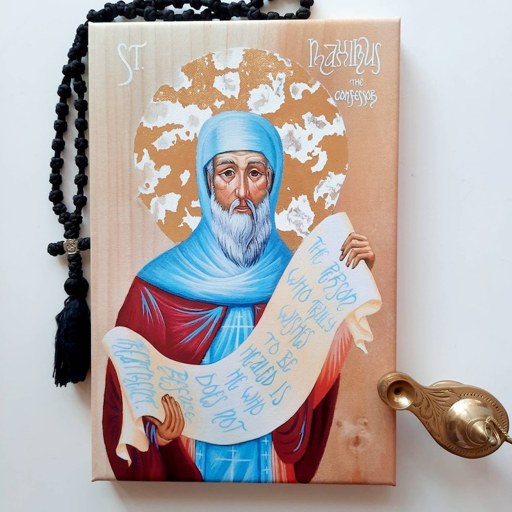
https://etsy.com/listing/1294340881/partly-hand-paintedgilded-st-maximus-the
License: unknown
Confessor Arsacius
Saint- Life Span
- d. 358
- Feast Day
- 16 August
- Gender
- male
- Church
- Catholic
Places
Roles & Family
Biography
Arsacius, commemorated in the Roman Martyrology as Confessor Arsacius, was a fourth-century Christian ascetic of Persian birth who lived at Nicomedia in Bithynia. The principal ancient witness to his life is the church historian Sozomen, writing in the mid-fifth century. According to that account, Arsacius had served among the soldiers of the emperor Licinius before withdrawing from the army and taking up a solitary, ascetic life in a tower of Nicomedia. Licinius ruled the East until his defeat by Constantine and death in 325, so Arsacius’s military service and subsequent eremitical withdrawal belong to the first decades of the fourth century. No reliable source records his year of birth, his native city in Persia, or any details of his family.
Sozomen states that Arsacius received from God the gifts of prophecy and of miracles. The episode for which he is remembered is bound to the great earthquake that destroyed Nicomedia on 24 August 358, an event independently attested by secular historians such as Ammianus Marcellinus. Perceiving that the disaster was at hand, Arsacius went through the city exhorting the inhabitants to pray and to repent of their sins. When no one heeded him, he returned to his tower. There he was found dead upon his knees in prayer. Immediately afterward the earthquake struck, overthrowing much of Nicomedia and causing heavy loss of life, among the dead being Bishop Cecropius of Nicomedia. The close conjunction of Arsacius’s death with that historically dated earthquake supplies the only secure year in his biography.
The martyrology styles him a confessor rather than a martyr. He is not said to have been put to death for the faith, though a Christian soldier in Licinius’s household would have lived through a period of renewed hostility to the Church in the eastern provinces. After leaving the army he lived as a hermit, not as a member of any later religious order, and no source attributes to him ecclesiastical office. He left no writings and founded no community. Apart from Sozomen’s brief notice and the corresponding entry in the Roman Martyrology, later legend did not substantially enlarge his story.
His feast is kept on 16 August. Veneration of Arsacius is of the ancient, pre-congregational kind; no formal act of canonization by a later pope is recorded. He is not widely invoked as patron of particular places, professions, or causes. His historical profile remains that of an obscure but well-attested eastern hermit whose death in prayer immediately preceded one of the notable natural calamities of the fourth-century Roman East.