Confessor Basolus is a saint of the Catholic Church (d. 620). Confessor Basolus's feast day is celebrated on 26 November.
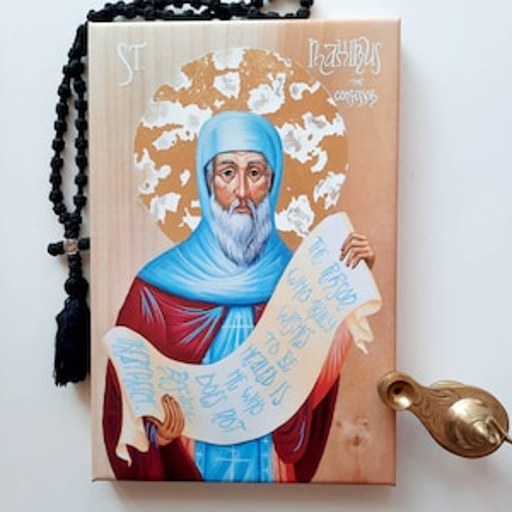
https://etsy.com/listing/1294340881/partly-hand-paintedgilded-st-maximus-the
License: unknown
Confessor Basolus
Saint- Life Span
- d. 620
- Feast Day
- 26 November
- Gender
- male
- Church
- Catholic
Places
Roles & Family
Biography
Saint Basolus, known in French as Basle and often called Basolus of Verzy or Basle of Reims, is a confessor listed in the Roman Martyrology on 26 November with a brief notice of his cult at Reims. He belongs to the large company of Merovingian holy men whose lives were transmitted by later monastic tradition rather than by contemporary documentary evidence. Reliable medieval notices, including those used by Jean Mabillon in the Acta Sanctorum Ordinis Sancti Benedicti and later summarized by Alban Butler, describe him as a native of Limoges in Aquitaine and as a man of noble family. The same tradition states that he spent part of his youth in military service before embracing the religious life, a pattern found in a number of Frankish saints of the sixth and seventh centuries. No verified year of birth survives; figures sometimes given in modern lists are reconstructions and should not be treated as documented fact.
He is said to have entered the monastery of Verzy, a short distance from Reims in Champagne. Later Benedictine authors associated that house with Saint Bercharius, though the usual chronology of Bercharius’s career sits uneasily with the death date customarily given for Basolus, and the connection should not be pressed. After some years in community—Butler, following his sources, speaks of seven years—Basolus received permission to live as a hermit. He withdrew to a neighbouring forest or hill, subsequently known as Mont Basle, and there passed several decades in austerity and prayer. Forty years of eremitical life is the figure given in the older accounts. Whether the community at Verzy already followed the Benedictine Rule in his day cannot be verified; later writers classified him among Benedictine saints because the medieval abbey that bore his name was Benedictine.
Hagiographers credit him with preaching and with miracles that led to conversions in the countryside around Reims, but they supply few names, dates, or independent corroborations. He is generally reported to have died about the year 620. His relics were translated to the cathedral of Reims, which became the principal centre of his cult. The abbey of Saint-Basle at Verzy, which took his name, kept his memory through the Middle Ages until its later decline and suppression. No contemporary vita survives; the outline of his life rests on these later monastic and martyrological notices.
Basolus was venerated as a confessor, not as a martyr. His cult remained essentially regional, tied to Reims and Verzy, and he was never the object of a formal papal canonization of the type that became standard after the twelfth and thirteenth centuries. He does not appear as a widely invoked patron of particular causes, professions, or places beyond the local honour paid him in Champagne. The scarcity of early sources means that many details of his biography—the precise rule followed at Verzy in his day, the specific events of his hermitage, and any family life before he became a monk—cannot be verified and should be left in the realm of pious tradition rather than established fact.