Confessor Benedict Joseph Labre is a saint of the Catholic Church (1748 - 1783). Confessor Benedict Joseph Labre's feast day is celebrated on 16 April. Confessor Benedict Joseph Labre is the patron saint of homeless people;beggars;people with mental illness;bachelors;pilgrims.
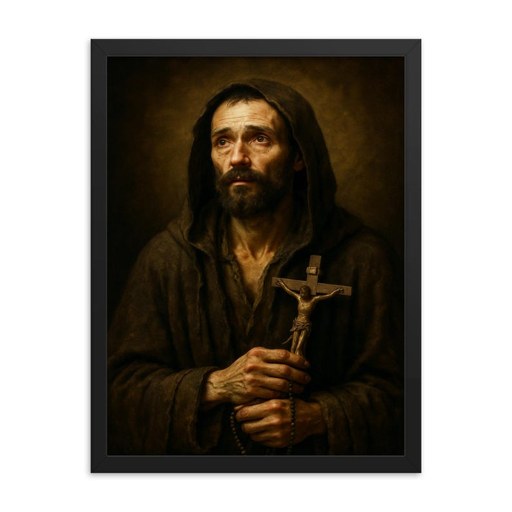
https://www.etsy.com/hk-en/listing/4362147498/benedict-joseph-labre-framed-print
License: unknown
Confessor Benedict Joseph Labre
Saint- Life Span
- 1748 - 1783 (age 35)
- Feast Day
- 16 April
- Gender
- male
- Church
- Catholic
Places
Roles & Family
Religious Information
Patronage
homeless people;beggars;people with mental illness;bachelors;pilgrims
Canonization
Biography
Benedict Joseph Labre was born on 26 March 1748 in Amettes, a village in Artois in northern France, the eldest of fifteen children of Jean-Baptiste Labre, a shopkeeper, and Anne-Barbe Grandsire. His family was pious and of modest means. As a boy he was sent to live with an uncle who was parish priest at Erin, where he studied Latin and was prepared with a view to the priesthood. After that uncle died he stayed with another priest-uncle. From an early age he practiced austerities and showed a desire for a life of prayer and withdrawal from the world.
In his late adolescence and early adulthood he sought to enter several of the strictest contemplative orders then established in France. He applied to Carthusian houses, to the Cistercians of Sept-Fons, and to the Trappists of La Trappe. In each case he was refused or, after a brief trial, dismissed. The reasons given were his weak constitution, scrupulosity, and an apparent inability to adapt to community life. These rejections, which later devotion associated with his patronage of those turned away from religious institutes, led him to abandon the attempt to become a choir monk.
From about 1770 he embraced a vocation of perpetual pilgrimage and voluntary destitution. He traveled on foot to shrines across France, Switzerland, Germany, Spain, and Italy, including Santiago de Compostela and the Holy House of Loreto, living on alms and sleeping wherever he could. He eventually settled chiefly in Rome, where he lived as a homeless beggar, often passing the night in the ruins of the Colosseum. He spent his days visiting churches, hearing multiple Masses, and remaining long hours in adoration of the Blessed Sacrament, particularly during the Forty Hours Devotion. He was a member of the Third Order of Saint Francis. Contemporaries described him as filthy, verminous, and silent; many thought him insane, while others discerned holiness in his patience and recollection.
On 16 April 1783, the Wednesday of Holy Week, he collapsed after Mass outside the church of Santa Maria ai Monti in Rome and was taken to a nearby house, where he died the same day. He was thirty-five years old. An immediate popular cult arose; his body was exposed in the church and he was buried there. Reports of miracles circulated quickly. He was beatified by Pope Pius IX on 20 May 1860 and canonized by Pope Leo XIII on 8 December 1881. His liturgical feast is observed on 16 April. He is invoked as patron of homeless people, beggars, pilgrims, unmarried men, and those who suffer from mental illness.