Confessor Benedict is a saint of the Catholic Church (d. 547). Confessor Benedict's feast day is celebrated on 11 July. Confessor Benedict is the patron saint of Europe;monks;students;schoolchildren;against poison;against witchcraft;dying people;farmers;kidney disease;fever.
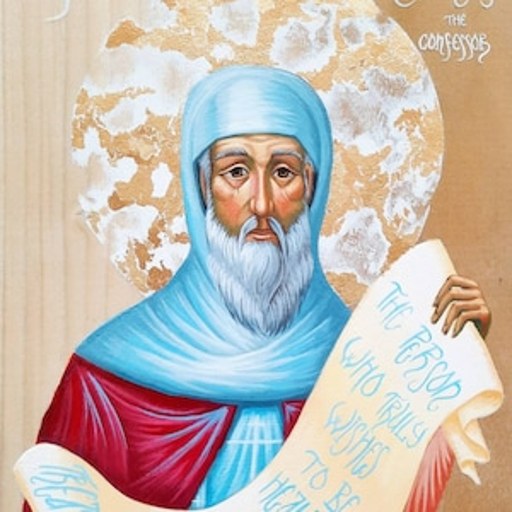
https://www.etsy.com/market/saint_maximus_the_confessor_icon
License: unknown
Confessor Benedict
Saint- Life Span
- d. 547
- Feast Day
- 11 July
- Gender
- male
- Church
- Catholic
Places
Roles & Family
Religious Information
Patronage
Europe;monks;students;schoolchildren;against poison;against witchcraft;dying people;farmers;kidney disease;fever
Biography
Benedict of Nursia, known in Western hagiographical and liturgical tradition as a confessor (a saint who was not a martyr), is the sixth-century Italian monk regarded as the father of Western monasticism. The principal historical source for his life is the second book of the Dialogues of Pope Gregory the Great, written in the 590s on the basis of testimony from Benedict’s own disciples. Gregory states that Benedict was born in Nursia (modern Norcia) in Umbria to a family of standing and was sent as a youth to Rome for literary studies. Dismayed by the moral disorder of the city, he abandoned his education and withdrew from the world, first to Enfide and then to a cave at Subiaco, where he lived as a hermit for about three years, receiving bread from a monk named Romanus.
His reputation for holiness drew disciples and, later, an invitation to serve as abbot of a community at Vicovaro. The monks found his discipline too severe and, according to Gregory, attempted to poison him; the vessel shattered when Benedict blessed it. He returned to Subiaco and organized his growing following into twelve small monasteries. Around 529 he transferred to Monte Cassino, a hill between Rome and Naples still occupied by a temple of Apollo. He converted the local people, demolished the pagan sanctuary, and built oratories dedicated to Saint John the Baptist and Saint Martin. It was there that he composed the Rule that bears his name, a moderate and psychologically acute guide to communal life centered on the Divine Office, manual labor, sacred reading, and stability under an abbot. The Rule became the foundational document of Benedictine monasticism and, through Carolingian promotion, of much of medieval European religious culture.
Gregory attributes numerous miracles to Benedict, among them the detection of poisoned food and drink, the multiplication of provisions, the raising of a dead child, and prophetic knowledge of distant events. Benedict’s twin sister Scholastica had likewise dedicated herself to God and lived in a nearby community of nuns; their final meeting, in which her prayer brought a storm that prolonged their conversation, is one of the best-known episodes in the Dialogues. Tradition holds that Benedict died at Monte Cassino on 21 March 547 after receiving Communion, standing with arms raised in prayer, supported by his monks. He was buried in the same grave as Scholastica. The precise year of his birth is not given by contemporary sources and remains unknown; later convention places it about 480. His cult is ancient and pre-dates the formal papal canonization process. Pope Paul VI declared him principal patron of Europe in 1964. In the General Roman Calendar his feast is kept on 11 July, the date associated with the translation of relics; older Western calendars and some Eastern observances retain 21 March (or 14 March in certain Orthodox usages).