Confessor Bernard is a saint of the Catholic Church (1090 - 1153). Confessor Bernard's feast day is celebrated on 20 August. Confessor Bernard is the patron saint of Cistercian Order;Burgundy;Gibraltar;beekeepers;candlemakers;wax refiners;Speyer;Queens' College, Cambridge.
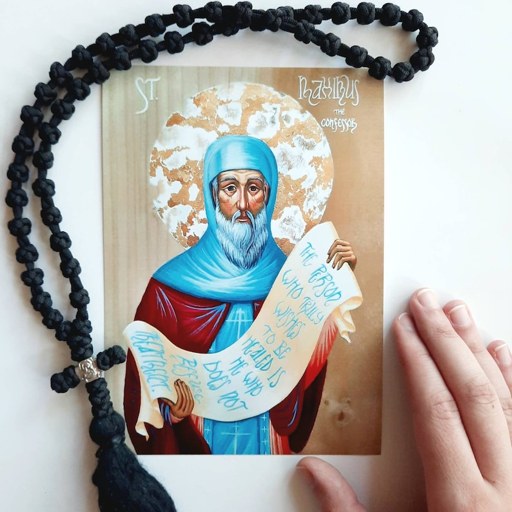
https://www.etsy.com/listing/1293702037/saint-maximus-the-confessor-icon-print
License: unknown
Confessor Bernard
Saint- Life Span
- 1090 - 1153 (age 63)
- Feast Day
- 20 August
- Gender
- male
- Church
- Catholic
Places
Roles & Family
Religious Information
Patronage
Cistercian Order;Burgundy;Gibraltar;beekeepers;candlemakers;wax refiners;Speyer;Queens' College, Cambridge
Canonization
Biography
Bernard of Clairvaux, the figure ordinarily intended in Latin martyrologies by the designation of Bernard the Confessor (Saint Bernard, abbot and confessor), was born in 1090 at the castle of Fontaine-lès-Dijon in the Duchy of Burgundy. He was the third of seven children of Tescelin, lord of Fontaine, a Burgundian noble in the service of the duke, and Aleth of Montbard, who was remembered for her piety and who died while Bernard was still an adolescent. He received a literary education with the secular canons of Saint-Vorles at Châtillon-sur-Seine. After a period of hesitation over a secular career, he entered the New Monastery at Cîteaux in 1113, bringing with him some thirty companions that included several of his brothers and other kinsmen. That influx of vocations helped stabilize the austere Cistercian reform begun by Robert of Molesme, Alberic, and Stephen Harding.
In 1115 Stephen Harding sent Bernard to found a daughter house in a forested valley of the Aube, which took the name Clairvaux (Clara Vallis). As founding abbot he enforced a strict reading of the Rule of Saint Benedict, with emphasis on poverty, silence, liturgical simplicity, and manual labor. Clairvaux grew rapidly and became the most influential house of the order; numerous daughter foundations spread from it through France, the British Isles, the Iberian Peninsula, Italy, and the Empire. Bernard consistently refused election to bishoprics and remained an abbot, yet from the 1120s he was among the most consulted churchmen in Latin Christendom. He supported Pope Innocent II against the antipope Anacletus II during the schism of 1130, traveling in France, Germany, and Italy to secure Innocent’s recognition. He composed an exhortation and a rule-related apology for the Knights Templar (In praise of the new knighthood) and remained a principal spiritual adviser to his former monk who became Pope Eugene III.
His writings circulated widely in his lifetime. The unfinished series of sermons on the Song of Songs became a central text of monastic mysticism. Treatises such as On Loving God, The Steps of Humility and Pride, the Apology addressed to William of Saint-Thierry in defense of Cistercian austerity, and On Consideration (written for Eugene III) shaped later medieval spirituality and papal self-understanding. He was also a determined controversialist. He moved against the teaching of Peter Abelard, whose positions were condemned at the Council of Sens in 1141, and he later opposed theological propositions associated with Gilbert of Poitiers. In 1146, at Vézelay, he preached the Second Crusade at Eugene III’s commission. The crusade’s failure in the East injured his standing in his final years, though he continued to write, to found monasteries, and to correspond with figures such as Malachy of Armagh.
Bernard died at Clairvaux on 20 August 1153 and was buried in the abbey church. Pope Alexander III canonized him on 18 January 1174. In 1830 Pope Pius VIII declared him a Doctor of the Church; he is known as Doctor Mellifluus, the Honey-Sweet Doctor, a title tied to the reputation of his preaching and to later iconography of bees and honey. Relics were disturbed when Clairvaux was seized in the French Revolution; remaining portions have been associated with the cathedral of Troyes. He remains the outstanding personality of the twelfth-century Cistercian movement and one of the principal spiritual writers of the medieval West.