Confessor Diego is a saint of the Catholic Church (d. 1463). Confessor Diego's feast day is celebrated on 13 November. Confessor Diego is the patron saint of San Diego, California;Diocese of San Diego;Franciscan lay brothers.
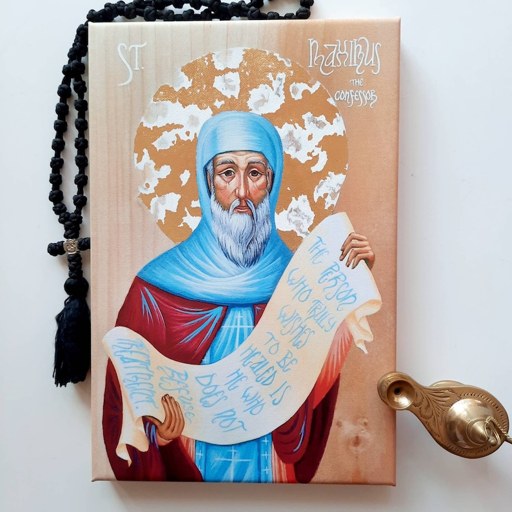
https://etsy.com/listing/1294340881/partly-hand-paintedgilded-st-maximus-the
License: unknown
Confessor Diego
Saint- Life Span
- d. 1463
- Feast Day
- 13 November
- Gender
- male
- Church
- Catholic
Places
Roles & Family
Religious Information
Patronage
San Diego, California;Diocese of San Diego;Franciscan lay brothers
Canonization
Biography
Saint Didacus of Alcalá, known in Spanish as San Diego de Alcalá and listed in older martyrologies as Didacus, Confessor, was a Franciscan lay brother of the fifteenth century. He was born in the village of San Nicolás del Puerto in the Sierra Morena of Andalusia, in the Kingdom of Castile, around the beginning of the fifteenth century; no precisely documented birth year survives. As a young man he lived for a time as a hermit in the nearby countryside, combining manual labor with prayer and giving much of what he earned to the poor. He later sought admission to the Order of Friars Minor and was received as a lay brother. In the Franciscan houses of southern Spain he was assigned the humblest offices, especially those of cook and porter, which he carried out with a spirit of recollection that already distinguished him among his brethren.
About 1441 he was sent to the Canary Islands, then a recent field of Franciscan missionary work. He served at the convent on Fuerteventura and, though a lay brother rather than a priest, was appointed guardian of that community. Accounts of his time there emphasize charity toward the poor and sick and zeal among the indigenous Guanche population. Recalled to Spain after some years, he was sent to Rome in 1450 for the Jubilee and the canonization of Saint Bernardino of Siena. He remained at the Franciscan convent of Santa Maria in Aracoeli during an epidemic, nursing the sick and gaining a contemporary reputation for miraculous healings.
He spent his last years at the Observant Franciscan house in Alcalá de Henares. There he lived in austerity, contemplation, and humble service until his death on 12 November 1463. Reports of an incorrupt body and of miracles at his tomb spread quickly. In 1562 King Philip II of Spain had the relics brought to the bedside of his gravely injured son, the Infante Carlos; the prince’s recovery was attributed to Didacus and gave strong impetus to the cause of canonization. Pope Sixtus V canonized him on 2 July 1588. He is often noted as the first lay brother of the Franciscan family to be raised to the honors of the altar.
Devotion to him spread throughout the Spanish world. When Franciscan missionaries under Junípero Serra founded the first mission in Alta California in 1769, they placed it under his patronage, and the settlement that grew around Mission San Diego de Alcalá became the city of San Diego. His feast is kept on 13 November. Relics of the saint are preserved in the Magistral Cathedral of Saints Justus and Pastor in Alcalá de Henares.