Confessor Edmund Rich is a saint of the Catholic Church (d. 1240). Confessor Edmund Rich's feast day is celebrated on 16 November. Confessor Edmund Rich is the patron saint of Abingdon;Roman Catholic Diocese of Portsmouth.
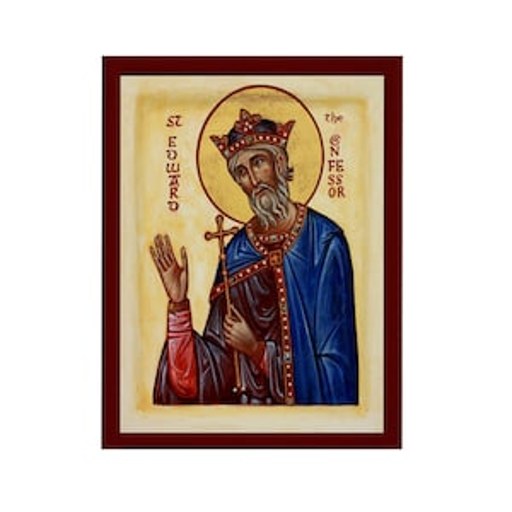
https://etsy.com/listing/935612497/saint-edward-icon-handmade-greek
License: unknown
Confessor Edmund Rich
Saint- Life Span
- d. 1240
- Feast Day
- 16 November
- Gender
- male
- Church
- Catholic
Places
Roles & Family
Patronage
Abingdon;Roman Catholic Diocese of Portsmouth
Canonization
Biography
Edmund Rich, also known as Edmund of Abingdon and Saint Edmund of Canterbury, was an English scholar and Archbishop of Canterbury in the first half of the thirteenth century. He was born in Abingdon in Berkshire to a family of comfortable means. His father, Reginald or Reynold Rich, is described in the sources as a merchant; his mother, Mabel, was remembered for her piety and for the care she took over her sons' education after her husband's death or withdrawal from secular life. Edmund studied in the schools of Oxford and at the University of Paris. He taught the liberal arts at Oxford and, after further study in theology, lectured in that faculty as well. Accounts of his life, including those written for his canonization, emphasize an austere personal regimen of fasting, limited sleep, and the wearing of a hair shirt, which he is said to have continued throughout his later public career.
In the 1220s he was made treasurer of Salisbury Cathedral, a position that involved both administration of the chapter's revenues and a public role as preacher. He was known as a promoter of ecclesiastical reform and took part in preaching the crusade. In 1233 he was elected Archbishop of Canterbury after a contested process in which a royal nominee failed to obtain acceptance. He was consecrated in 1234. As archbishop he attempted to restore discipline among the clergy, to visit religious houses, and to defend the liberties of the English church against royal pressure. In 1234 he was involved in the political movement that led to the removal of Peter des Roches and other Poitevin advisers of King Henry III. His relations with the king nevertheless remained difficult, especially over the filling of benefices, the taxation of the clergy, and the independence of ecclesiastical courts.
Edmund also came into conflict with the Benedictine monks of Christ Church, Canterbury, who formed the cathedral chapter, over rights of visitation and customary privileges. He objected to certain papal provisions that placed non-resident or foreign clerks in English livings, even while he remained loyal to the papacy in principle. Finding his position increasingly isolated, he left England in 1240 and withdrew to the Cistercian abbey of Pontigny in Burgundy, a house already associated with the exiles of Archbishops Thomas Becket and Stephen Langton. Intending to proceed to the papal court, he became ill and was taken to the canons' house at Soisy, near Provins, where he died on 16 November 1240. His body was carried to Pontigny and buried in the abbey church.
Miracles were reported at his tomb, and a cult developed rapidly. Pope Innocent IV canonized him in 1246. Edmund is venerated as a confessor rather than a martyr. His feast is kept on 16 November. The principal work attributed to him is the Speculum ecclesiae, a handbook of spiritual and pastoral instruction. Medieval chroniclers, including Matthew Paris, and the lives composed for the canonization process are the main narrative sources; they are generally consistent on his career and death, though they include conventional hagiographical episodes concerning his childhood and wonders. His shrine at Pontigny attracted pilgrims through the later Middle Ages. He is honoured as patron of Abingdon and of the Roman Catholic Diocese of Portsmouth, and his name was given to academic foundations in Oxford and among English Catholics in later centuries.