Confessor Edward is a saint of the Catholic Church (d. 1066). Confessor Edward's feast day is celebrated on 13 October. Confessor Edward is the patron saint of England;kings;difficult marriages;separated spouses.
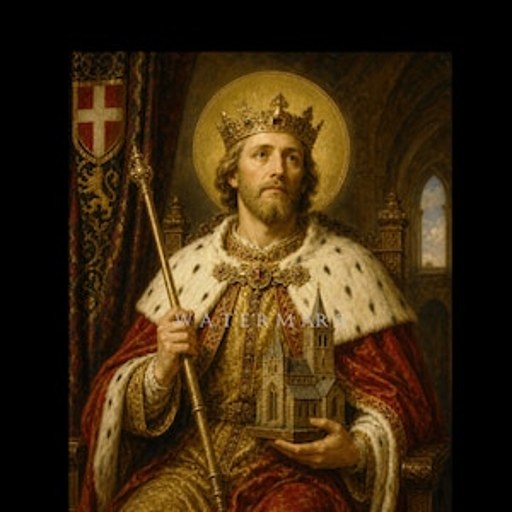
https://www.etsy.com/uk/market/saint_edward_the_martyr_icon
License: unknown
Confessor Edward
Saint- Life Span
- d. 1066
- Feast Day
- 13 October
- Gender
- male
- Church
- Catholic
Places
Roles & Family
Religious Information
Patronage
England;kings;difficult marriages;separated spouses
Canonization
Biography
Edward, known as the Confessor, was an Anglo-Saxon king of England and a canonized saint of the Latin Church. He was born in the early eleventh century, most often placed between 1003 and 1005, as a son of King Æthelred II and Emma of Normandy. His early life was shaped by the Danish conquest of England. After the invasions of Sweyn Forkbeard and Cnut, Edward spent a long exile in Normandy among his mother's kin, remaining there for roughly a quarter of a century. That Norman upbringing later coloured his court, his friendships, and some of his ecclesiastical appointments when he returned to rule in England.
He came back to England in 1041 and succeeded his half-brother Harthacnut as king in 1042. His reign, which lasted until 1066, was comparatively peaceful after decades of Viking warfare, though it was dominated by the powerful Earl Godwin of Wessex and Godwin's sons. In 1045 Edward married Edith, Godwin's daughter. The marriage remained childless. Later medieval writers attributed this to a vow of chastity on Edward's part; modern historians treat that claim with caution and note simply that no heir was born, a fact that proved politically decisive. Tensions with the Godwin family produced a brief exile of the earl in 1051 and a subsequent restoration, after which Godwin's house remained central to English politics for the rest of the reign.
Edward was already renowned in his lifetime for personal piety. He devoted substantial resources to rebuilding the Benedictine monastery at Westminster, raising a large Romanesque church that became both his burial place and a royal mausoleum. He died on 5 January 1066 and was interred in Westminster Abbey. His death without a clear successor precipitated the succession crisis of 1066, including the rival claims of Harold Godwinson and William of Normandy and, ultimately, the Norman Conquest.
A cult formed around Edward soon after his death. He was canonized in 1161 by Pope Alexander III, during the reign of Henry II, and his body was solemnly translated in Westminster Abbey in 1163 in the presence of the king and Archbishop Thomas Becket. His principal feast is kept on 13 October, the date of that translation. He was long regarded as a patron of England and has been invoked as a patron of kings and of those in difficult or childless marriages. His shrine at Westminster remained a focus of royal and popular devotion through the later Middle Ages.