Confessor Epiphanius is a saint of the Catholic Church (d. 403). Confessor Epiphanius's feast day is celebrated on 12 May.
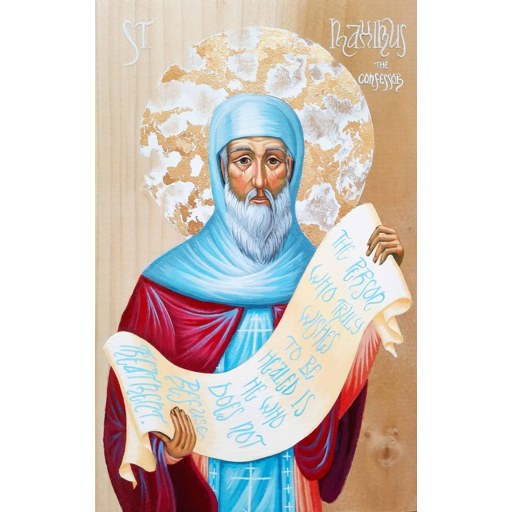
https://etsy.com/listing/1294340881/partly-hand-paintedgilded-st-maximus-the
License: unknown
Confessor Epiphanius
Saint- Life Span
- d. 403
- Feast Day
- 12 May
- Gender
- male
- Church
- Catholic
Places
Roles & Family
Biography
Epiphanius of Salamis, commemorated in East and West as a bishop and confessor, was a fourth-century monk, metropolitan of Cyprus, and one of the most industrious heresiologists of the early Church. He was born in the early fourth century in the village of Besanduc near Eleutheropolis in Roman Palestine. As a young man he took up the monastic life and spent a formative period among the monks of Egypt, absorbing both the ascetic discipline and the anti-heretical severity of that world. Returning to Palestine, he founded a monastery at Besanduc and remained its abbot for many years. Ancient witnesses credit him with unusual linguistic range—Greek, Syriac, Hebrew, Coptic, and some Latin—which later earned him the epithet of a man of five tongues. A later legendary Life that makes him the child of Jewish parents who converted in youth is not historically secure and is treated with caution by modern scholars.
In the later 360s he was elected bishop of Constantia, the city also called Salamis, on the east coast of Cyprus, and thereby metropolitan of the island churches. He held the see for some thirty-five years. From Cyprus he corresponded across the eastern Mediterranean and intervened in disputes in Palestine and Egypt. He supported the old-Nicene, Paulinian side in the schism at Antioch, aligning himself with Rome and Alexandria rather than with the Meletian majority in the East. He was a determined enemy of teachings he labelled Origenist. His relations with John of Jerusalem collapsed after he preached against Origen in Jerusalem and ordained a priest within John’s jurisdiction without consent. In a letter to John he also described tearing down a church curtain bearing an image at Anablatha, an incident later cited in arguments over images, though the exact scope of his objection remains debated.
His chief surviving works are the Ancoratus, a compact exposition of doctrine, and the Panarion (Medicine Chest), a vast survey of some eighty heresies from the earliest sects to his own generation. The Panarion preserves quotations from otherwise lost sources, but it is also a work of polemic whose historical reliability is uneven and must be used with care. He further wrote a treatise known as On Weights and Measures, concerned with biblical topography and measures, together with other shorter pieces. He was an ally of Jerome in the Origenist controversy; the two men met and Jerome dedicated work to him. In 402–403 Epiphanius was drawn to Constantinople in the struggle surrounding John Chrysostom, appearing there at the urging of Theophilus of Alexandria. Contemporary historians do not agree on how far he committed himself against Chrysostom; a widely received account holds that he declined to join a formal condemnation and left the capital.
He died in 403, according to the usual report while still at sea on the voyage back from Constantinople to Cyprus. His body was taken to Constantia and buried there. Veneration of him as a saint is ancient in both the Greek East and the Latin West, and his feast is kept on 12 May. He was never a patriarch or bishop of Rome; his rank was that of bishop of Salamis and metropolitan of autocephalous Cyprus. His writings remain a major, if tendentious, source for the history of early Christian sects and for the Origenist conflicts of the late fourth century, and liturgical tradition remembers him as confessor of the Nicene faith rather than as a martyr.