Confessor Farrell is a saint of the Catholic Church.
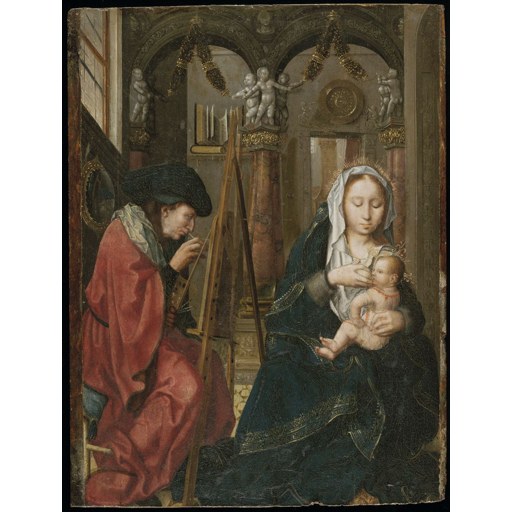
https://en.wikipedia.org/wiki/Saint_Luke_painting_the_Virgin
License: unknown
Confessor Farrell
Saint- Gender
- male
- Church
- Catholic
Roles & Family
Biography
The designation “Confessor Farrell” cannot be matched with certainty to any saint, blessed, or venerable whose life is recorded in the principal Western or Eastern hagiographical corpora. Standard reference works—including the Roman Martyrology, the Martyrology of Donegal, John O’Hanlon’s Lives of the Irish Saints, and the Bibliotheca Hagiographica Latina—contain no entry under this precise name. In Christian usage the title “Confessor” traditionally distinguishes a holy person who bore witness to the faith through piety, exile, or suffering short of violent martyrdom; it is a category of sanctity rather than a personal forename. Joined to the Irish surname Farrell (Ó Fearghail), the phrase most plausibly reflects a local or familial memory of a pious cleric or monk rather than a universally culted saint whose acta survive.
The Ó Fearghail were a prominent Gaelic family whose ancestral territory lay in Annaly, corresponding roughly to modern County Longford in the Irish midlands. From the early medieval period onward, members of such dynasties commonly held ecclesiastical offices as abbots, bishops, and erenaghs within the Irish church. It is therefore historically conceivable that one or more Farrells lived as monks or secular priests of notable holiness and were remembered in oral tradition as confessors. Irish ecclesiastical history is rich in similarly obscure holy men whose cults never spread beyond a parish, a monastery, or a family. No contemporary annalistic notice, no surviving vita, and no liturgical calendar entry has been identified that would allow a historian to assign a monastery, a diocese, or even a century to a person specifically called Confessor Farrell.
As a result, no verified year of birth or death can be supplied, nor any place of birth, death, or burial. There is no evidence that the subject occupied the see of Rome or any patriarchal or catholicosal throne of the Orthodox, Oriental Orthodox, Coptic, or Church of the East traditions. No documentation of a spouse or of children has been found; if the individual was a monastic confessor, celibacy would be expected, but that inference remains undemonstrated. No feast day appears in diocesan or national calendars, and no patronages of places, professions, illnesses, or groups are attached to the name in published sources. Neither a papal canonization nor a beatification process is recorded for this designation.
Later readers sometimes conflate similarly spelled Irish names. Saint Virgilius of Salzburg (also Feargal or Fergal), an eighth-century Irish missionary bishop and scholar, is occasionally rendered in English sources in ways that approach “Farrell,” yet he is universally known by his Latin name, his cult is well documented, and his feast is kept on 27 November. Other early Irish saints named Fergna or Fergil likewise possess distinct identities, feast days, and literary traditions. In the absence of a matching feast, relic cult, or medieval text, Confessor Farrell must be treated as an unverified or purely local figure. A responsible account therefore records the limits of present knowledge rather than constructing a biography from conjecture.