Confessor Francis is a saint of the Catholic Church.
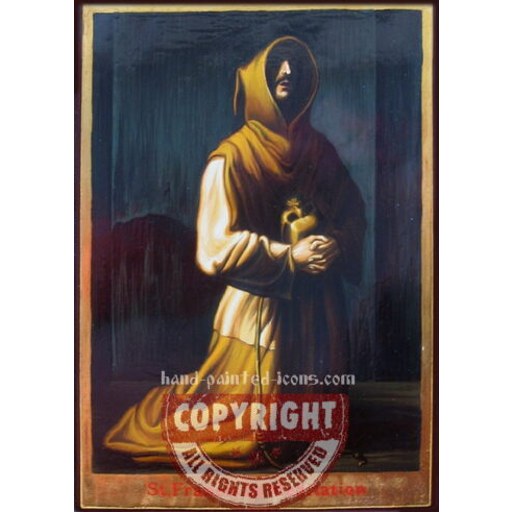
https://hand-painted-icons.com/category/saints-and-angels/saint-emilianos-the-confessor
License: unknown
Confessor Francis
Saint- Church
- Catholic
Biography
The designation Confessor Francis does not correspond to a single, uniquely identifiable person in the principal martyrologies, synaxaria, or standard modern reference works of Catholic, Orthodox, or Anglican hagiography. In Latin Christian usage the title Confessor marked a male saint who was not a martyr: originally one who had confessed the faith under persecution and survived, and later, more broadly, a priest, monk, hermit, or bishop commemorated for holiness of life. The given name Francis (Francesco, Franciscus) became extremely common after the thirteenth century because of the fame of Francis of Assisi, so liturgical books, order necrologies, and local calendars contain many entries that could be styled Francis, confessor. Without a feast date, diocese, monastery, religious order, or other independent identifier, birth and death years, places, and family details cannot be assigned to this exact form of the name.
Well-documented saints named Francis who are classed as confessors include Francis of Assisi (died in the early thirteenth century in Umbria), Francis of Paola (Calabria, fifteenth–sixteenth centuries), Francis Xavier (Navarre and the East Indies, sixteenth century), and Francis de Sales (Savoy, sixteenth–seventeenth centuries). Each of these men has a distinct cult, feast, and body of sources, but none is customarily indexed simply as Confessor Francis. Franciscan, Capuchin, Jesuit, and diocesan necrologies list still further priests and brothers called Francis who were remembered as confessors either in the older sense of confessors of the faith or in the later sacramental sense of priests who heard confessions. Any of those obscure figures might theoretically be intended; none can be verified as the subject here.
Because the identity remains uncertain, no reliable chronicle, process of canonization, or liturgical proper supplies a birth year, death year, birthplace, death place, or burial site that can be attached to Confessor Francis as a unique individual. There is likewise no documented spouse, offspring, papal or patriarchal office, or specific list of patronages that can be attributed without conflating distinct persons. Beatification and canonization, when they occurred, were acts concerning named individuals with known sees or orders; those acts cannot be transferred to an unspecified Confessor Francis. Historical method therefore requires that chronological, geographical, and familial fields be left blank rather than filled by analogy with better-known namesakes.
The liturgical category itself has a long history. Early Church usage distinguished confessors from martyrs; medieval kalendars used Confessor as a class for non-martyr male saints, often abbreviated in martyrologies. Religious orders, especially the Franciscans, produced many such commemorations, and some archival lists name a brother only as Francis, confessor. That scribal habit may explain the present designation, but it does not yield a recoverable biography. Until a feast day, a house of profession, a contemporary notice, or a catalogue number is produced, the subject must be treated as unidentified, and no patronage, canonization, or family data can be stated as fact.