Confessor Fursey is a saint of the Catholic Church (d. 650). Confessor Fursey's feast day is celebrated on 16 January. Confessor Fursey is the patron saint of Péronne.
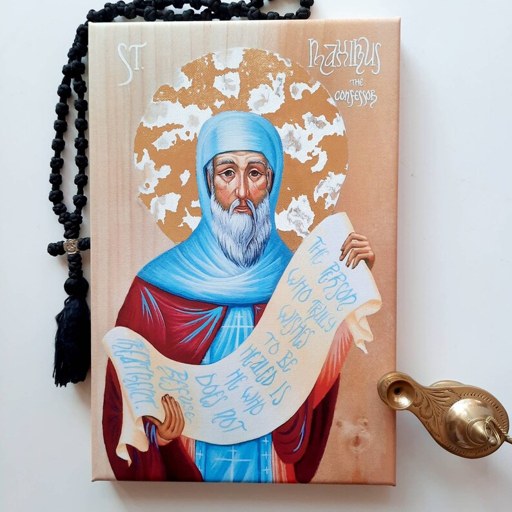
https://etsy.com/listing/1294340881/partly-hand-paintedgilded-st-maximus-the
License: unknown
Confessor Fursey
Saint- Life Span
- d. 650
- Feast Day
- 16 January
- Gender
- male
- Church
- Catholic
Places
Roles & Family
Patronage
Péronne
Canonization
Biography
Saint Fursey (Irish Fursa; Latin Furseus), known as a confessor, was a seventh-century Irish monk, missionary, and visionary whose work linked the churches of Ireland, Anglo-Saxon East Anglia, and Merovingian Gaul. The principal early source is the Vita Sancti Fursei, composed within a generation of his death and used by Bede in Book III of the Ecclesiastical History of the English People. That tradition presents him as the son of Fintan, of Munster royal stock, and of Gelges, of Connacht royal lineage. Raised a Christian, he entered the monastic life and founded a community at Rathmat, commonly identified with Killursa beside Lough Corrib in western Ireland. From this house he gathered disciples, including his brothers Foillan and Ultan.
In the early seventh century Fursey left Ireland for Britain and arrived in East Anglia during the reign of King Sigeberht, a ruler converted while in exile among the Franks. Sigeberht granted him a site at Cnobheresburg, identified with the Roman shore fort at Burgh Castle in Norfolk, where an Irish-style monastery was established. During these years Fursey experienced the visions that made him famous. Bede relates that he was taken up by angels and shown the blessedness of the just and the punishments of the wicked; he was burned by demonic fire as a warning against lingering attachment to a cloak once accepted from a sinner, and he returned to his body with lasting dread. These visions rank among the earliest fully developed Christian otherworld journeys from the British Isles and later influenced medieval vision literature.
Unrest in East Anglia, associated with the campaigns of the Mercian king Penda, led Fursey to leave England after a number of years. He placed the monastery under Foillan and crossed to Gaul, where he was received by Erchinoald, mayor of the palace of Neustria, and by King Clovis II. Fursey founded a monastery at Lagny-sur-Marne, east of Paris, as a centre of Irish monastic observance. While travelling in Picardy he fell ill and died, according to the date long observed in his cult, on 16 January 650. Some accounts name Mézerolles in Ponthieu as the place of death. His body was taken to Péronne, where Erchinoald built a church; Fursey was buried there, and the site became an Irish monastic foundation known as Peronna Scottorum. Bede notes that the body was later found incorrupt when translated.
Fursey’s cult spread in Ireland, England, and Francia. He is commemorated as a confessor on 16 January and is regarded as a patron of Péronne. His brothers continued monastic work in northern Francia and the Low Countries. The written record of his visions, preserved by Bede and in the independent Vita, gave him a lasting place in Christian eschatological literature. Precise details of his birth year and some local identifications remain uncertain, but the outline of his missionary career and the impact of his otherworld experiences are attested in seventh- and eighth-century sources.