Confessor Gaetan of Tiene is a saint of the Catholic Church (1480 - 1547). Confessor Gaetan of Tiene's feast day is celebrated on 7 August. Confessor Gaetan of Tiene is the patron saint of the unemployed;job seekers;bankers;workers;Argentina;people struggling with gambling.
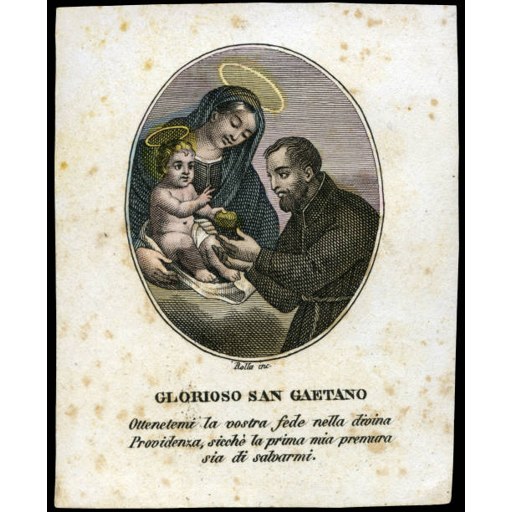
https://gettyimages.com/photos/saint-gaetano-of-thiene
License: unknown
Confessor Gaetan of Tiene
Saint- Life Span
- 1480 - 1547 (age 67)
- Feast Day
- 7 August
- Gender
- male
- Church
- Catholic
Places
Roles & Family
Religious Information
Patronage
the unemployed;job seekers;bankers;workers;Argentina;people struggling with gambling
Canonization
Biography
Gaetano dei Conti di Thiene, known in English as Saint Cajetan and in older liturgical and hagiographical usage as Confessor Gaetan of Tiene, was born in October 1480 at Vicenza in the Republic of Venice. He belonged to the noble Thiene family; his father was Count Gaspare di Thiene and his mother was Maria da Porto. After his father's death he was raised by his mother, who was known for piety. He studied at the University of Padua and in 1504 received doctorates in both civil and canon law. He then went to Rome and obtained a post as apostolic protonotary in the court of Pope Julius II. The office gave him status and income, but contemporaries already remarked on his personal austerity, frequent prayer, and dissatisfaction with the worldliness of many clerics at the papal court.
He was ordained to the priesthood in 1516, relatively late for a man of his rank, and thereafter devoted himself more openly to reform and charity. In Rome he joined the Oratory of Divine Love, a confraternity that combined frequent reception of the sacraments with care of the sick, especially at the hospital of San Giacomo. He also worked to revive clerical life in Vicenza and Venice. Convinced that the Church needed priests who lived in community according to the evangelical counsels, celebrated the liturgy with care, and undertook pastoral work without seeking benefices or private property, he joined with Gian Pietro Carafa, bishop of Chieti (later Pope Paul IV), Bonifacio da Colle, and Paolo Consiglieri. In 1524 Pope Clement VII approved their Congregation of Clerics Regular, soon called the Theatines from Carafa's see of Chieti, known in Latin as Theate. The new institute was small, strict, and urban. After the Sack of Rome in 1527 the community fled to Venice, where Cajetan served as superior.
From the 1530s Cajetan's principal field of work was the Kingdom of Naples. There he established a Theatine house, encouraged hospitals for the incurably ill, and promoted monti di pietà, charitable pawn institutions meant to spare the poor from usurious lenders. He preached, heard confessions, and insisted on a disciplined clergy. Traditional accounts stress his devotion to the Eucharist and to the Blessed Virgin; later hagiography records a vision in which Mary placed the Infant Jesus in his arms. He sought to meet the challenge of Protestant teaching in Italy chiefly by the example of a reformed priesthood and by works of mercy rather than by polemic alone. He died at Naples on 7 August 1547 and was buried in the Theatine church of San Paolo Maggiore.
The Theatines and the cities in which he had labored promoted his cult. He was beatified by Pope Urban VIII in 1629 and canonized by Pope Clement X on 12 April 1671. His feast is kept on 7 August. Popular devotion, especially in Italy and later in Latin America, has invoked him as patron of those without work and of those seeking employment; in Argentina he is widely venerated as San Cayetano, associated with bread and work. He is also regarded as a patron of bankers and of workers, a memory of his monti di pietà, and of persons struggling with gambling. As founder of one of the first congregations of clerks regular, he occupies a recognized place in the Catholic Reformation of the sixteenth century.