Confessor Isidore is a saint of the Catholic Church.
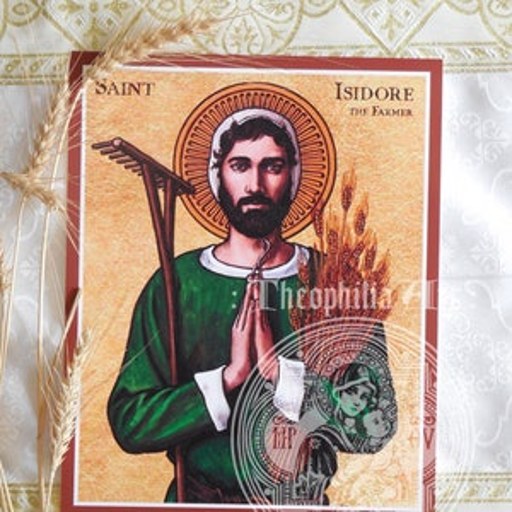
https://www.etsy.com/market/st_isidore_icon
License: unknown
Confessor Isidore
Saint- Gender
- male
- Church
- Catholic
Roles & Family
Biography
The heading Confessor Isidore does not identify a single, securely documented individual in the way that fixed epithets such as Maximus the Confessor or Theophanes the Confessor do. Isidore (Greek Isidōros) was a common Christian name in late antiquity and the Middle Ages. In Latin and Greek liturgical language, confessor (confessor, homologētēs) marks a saint who bore witness by a holy life, exile, or suffering short of execution. Several holy men of this name were later classed as confessors in different churches. Without a feast day, see, century, or toponym, a unique birth year, death year, burial place, or patronage list cannot be verified, and those fields are left blank rather than filled by conjecture.
In the medieval Latin church the best-known bishop-confessor so named is Isidore of Seville, who died in the first half of the seventh century and whose feast was kept on 4 April. He came from a Hispano-Roman family associated with Cartagena and Seville; his brother Leander preceded him as metropolitan of Seville and was central to the Visigothic court’s conversion from Arianism. Isidore’s episcopate in the early seventh century included the Second Council of Seville and the Fourth Council of Toledo and a large body of writing meant to preserve classical and patristic learning. The Etymologiae, the chronicle, and the history of the Goths were widely copied in the early Middle Ages. His cult at Seville is ancient; later Roman confirmation of the cult and, in the eighteenth century, the title Doctor of the Church did not make him pope or an Eastern patriarch, and there is no evidence that he married.
Egyptian monastic sources honor Isidore of Pelusium, a priest and ascetic of the eastern Nile Delta in the late fourth and early fifth centuries, commemorated on 4 February in Eastern and Western calendars. A large correspondence in his name addresses monks, bishops, and officials on scripture, clerical discipline, and the theological disputes of the age. He is usually styled venerable or abba; confessor is not his ordinary epithet, though the categories overlap. A later Western lay confessor, Isidore of Madrid (Isidore the Farmer or Laborer), is placed by Castilian tradition in the eleventh and twelfth centuries as a married agricultural worker, husband of Maria de la Cabeza. His cult was approved in the early seventeenth century, and he became patron of Madrid and of farmers. These are distinct persons and cannot be merged.
Eastern calendars also record Isidore of Chios, an early martyr rather than a confessor, and Isidore of Rostov, a fifteenth-century fool-for-Christ in northern Rus'. No Bishop of Rome has borne the name Isidore. Because the supplied heading gives no further identifier, none of these lives can be treated as the intended biography. Precise years, cities, religious orders, spouses, children, and patronages would require choosing among them and are therefore omitted.