Confessor Julian is a saint of the Catholic Church.
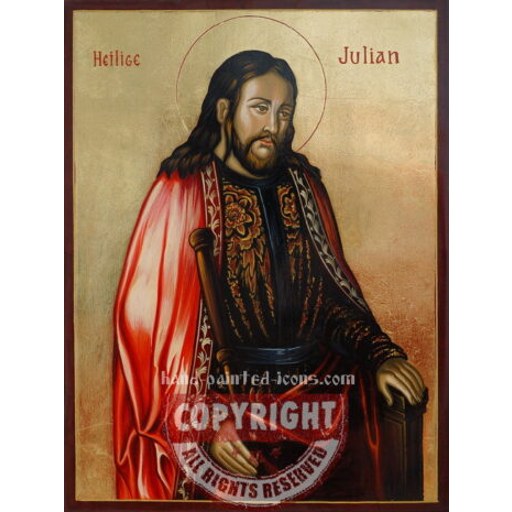
https://hand-painted-icons.com/category/saints-and-angels/saint-emilianos-the-confessor
License: unknown
Confessor Julian
Saint- Gender
- male
- Church
- Catholic
Roles & Family
Biography
The designation Confessor Julian does not correspond to a single, unambiguously identified historical figure in the principal Latin, Greek, Syriac, or Coptic hagiographical collections. The personal name Julianus was extremely common across the late Roman and early medieval Christian world, and the title confessor was applied both to those who suffered persecution, exile, or hardship for the faith without dying as martyrs and, more loosely, to holy bishops, priests, and monks. Martyrologies, synaxaria, and local calendars therefore contain several distinct men named Julian who are styled confessors, often with only a feast day, a city, and a brief epithet. No Wikidata identifier, Wikipedia article, feast date, see, or century was supplied with the present query, so these homonyms cannot be collapsed into one biography without conjecture.
Among better-attested Western candidates are the Julian traditionally venerated as first bishop of Le Mans in Gaul, whose cult is already visible in the Merovingian period and whose feast is kept on 27 January, and Julian of Cuenca, a Castilian cleric who taught at Palencia, became bishop of Cuenca in 1196, and died on 28 January 1208. Medieval legends later claimed the Le Mans bishop had been sent by the Apostle Peter; modern historians treat those stories as pious fiction and can establish neither a birth year nor a reliable death date for him. Even for Julian of Cuenca the year of birth remains uncertain in the sources. In the Christian East, Julian Sabas, a fourth-century hermit of Osrhoene or Mesopotamia known mainly through Theodoret of Cyrrhus, is sometimes called confessor; the notices give no natal year or precise birthplace. None of these identifications can be confirmed as the intended subject.
Standard reference works such as the Bibliotheca Hagiographica Latina, the Bibliotheca Hagiographica Graeca, and the Roman Martyrology therefore cannot be used to fill biographical fields without an arbitrary choice among homonyms. Birth and death years, cities, and burial sites that appear in later compilations are frequently legendary, or they are actually dates of episcopal consecration or of the translation of relics. Such figures are omitted here. No contemporary evidence records a spouse, children, or membership in a later religious order for an unspecified Confessor Julian. The great majority of men so titled were secular clergy or monks and thus presumed celibate, but presumption is not documentation.
No Bishop of Rome and no Coptic Pope of Alexandria is known to history under the simple designation Confessor Julian; the complete papal lists contain no pope of that name in the relevant sense. Patronages attached to various Saints Julian (the city of Le Mans, the diocese of Cuenca, hospitallers, ferrymen, hunters, and others) belong to particular local cults and cannot be transferred to an unidentified confessor. Canonization and beatification, where they occurred at all, were in most cases by local episcopal authority or popular acclaim long before the modern papal processes, and the names of the prelates involved are not preserved. Liturgical commemoration of confessors named Julian continues in both the Roman and Byzantine rites on several dates in January, February, and October, depending on the particular saint and the local calendar. Beyond that liturgical fact, a responsible historical account must remain silent rather than invent a coherent life from the scattered notices of several different men.