Confessor Lullus is a saint of the Catholic Church (d. 786). Confessor Lullus's feast day is celebrated on 16 October. Confessor Lullus is the patron saint of Hersfeld.
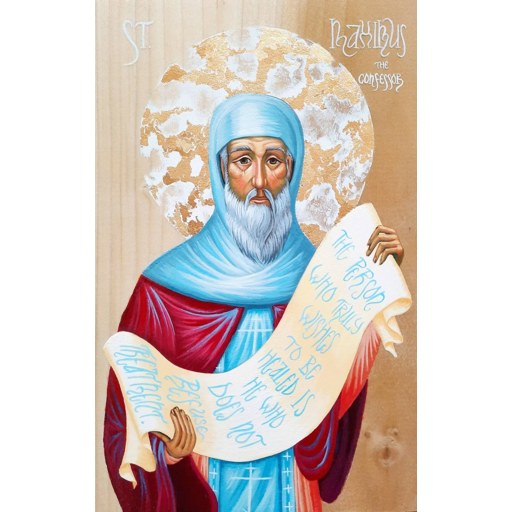
https://etsy.com/listing/1294340881/partly-hand-paintedgilded-st-maximus-the
License: unknown
Confessor Lullus
Saint- Life Span
- d. 786
- Feast Day
- 16 October
- Gender
- male
- Church
- Catholic
Places
Roles & Family
Religious Information
Patronage
Hersfeld
Biography
Saint Lullus (also spelled Lul or Lull), commemorated in the liturgical tradition as a bishop and confessor, was an Anglo-Saxon Benedictine monk who became bishop of Mainz and one of the principal organizers of the church in the Germanic lands during the eighth century. He was born in the kingdom of Wessex in southern England; no contemporary source records an exact year of birth, and the figure sometimes given in later handbooks is only a conventional estimate. He received his monastic formation at Malmesbury Abbey in Wiltshire, a house already known for the learning associated with Saint Aldhelm. From Malmesbury he went to the Continent, probably in the 730s, to join the missionary work of his fellow West Saxon Saint Boniface (Wynfrith), who was then preaching and founding churches in Hesse, Thuringia, and neighboring regions under papal mandate and Frankish protection.
Lullus became Boniface’s archdeacon and closest collaborator. He shared in preaching, in the foundation and reform of monasteries, and in the correspondence that bound the mission to Rome, to the Frankish mayors of the palace, and to bishops and abbots in England. In the early 750s Boniface consecrated him bishop so that episcopal oversight of the far-flung mission could be shared. When Boniface left for Frisia in 754, he named Lullus to succeed him at Mainz. After Boniface’s martyrdom near Dokkum that same year, Lullus took charge of the see. Under his long episcopate Mainz developed into one of the leading ecclesiastical centres of the Frankish kingdom. He kept up the English connection: several of his letters survive in the Bonifatian collection, including exchanges with English prelates about books, relics, and prayer.
His government of the church was not free of conflict. He sought to assert metropolitan rights over the abbey of Fulda, which Boniface had intended as his burial place and which the monk Sturm administered with a strong claim to independence. The dispute drew in King Pippin and later Charlemagne; Sturm was for a time removed and afterwards restored, and Fulda’s distinctive standing was in the end upheld. Lullus himself founded, or refounded and richly endowed, the monastery of Hersfeld in Hesse, traditionally in the late 760s, and had the relics of Saint Wigbert translated there. About 780 Pope Adrian I granted him the pallium, confirming metropolitan authority. He thus stood at the meeting point of Anglo-Saxon missionary tradition, Benedictine monasticism, papal recognition, and Carolingian church policy.
Lullus died at Hersfeld on 16 October 786 and was buried in the abbey church. A local cult grew up at his tomb. He is commemorated as a saint and confessor on 16 October. The town of Hersfeld (now Bad Hersfeld in Hesse) has long regarded him as its patron, and the medieval Lullusfest attached to his feast is among the oldest civic festivals in Germany. He was never the object of a formal papal canonization of the later medieval type; his sainthood belongs to the older pattern of episcopal and popular recognition. In the history of the German church he remains the most important English-born successor of Boniface and a chief architect of the see of Mainz in the Carolingian age.