Confessor Marcian is a saint of the Catholic Church. Confessor Marcian's feast day is celebrated on 10 January.
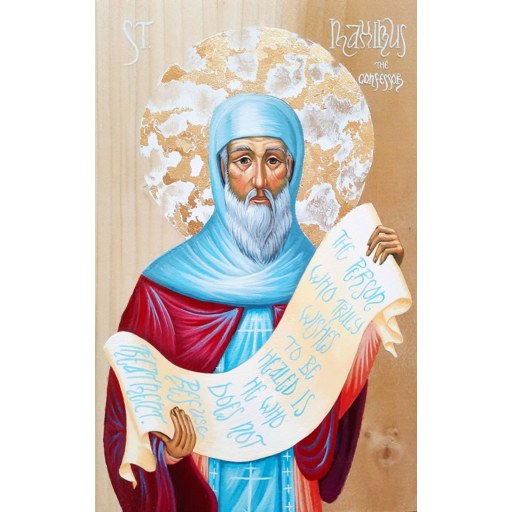
https://etsy.com/listing/1294340881/partly-hand-paintedgilded-st-maximus-the
License: unknown
Confessor Marcian
Saint- Feast Day
- 10 January
- Gender
- male
- Church
- Catholic
Places
Roles & Family
Biography
Saint Marcian, also called Marcianus in Greek sources, was a priest of the church of Constantinople in the fifth century. He is remembered in Eastern Orthodox and Roman Catholic tradition as a confessor, that is, a holy man who bore witness to the Christian faith without dying a martyr's death. Of a family of Roman origin and of some social standing, he lived and worked in the imperial capital during the reigns of Emperors Marcian (450-457) and Leo I (457-474). He was ordained priest by Patriarch Gennadius I and held the important office of oikonomos, or steward, of the Great Church, the cathedral complex of Hagia Sophia. In that role he administered substantial ecclesiastical property and revenues.
Hagiographical accounts emphasize Marcian's personal poverty and his lavish charity. Although his office and family background placed considerable resources at his disposal, he is described as giving freely to the poor, to travelers, and to the sick, to the extent that he sometimes lacked even basic necessities himself. He is credited with founding or supporting xenodocheia, hostels for strangers and the destitute, and with acting as a protector of widows and orphans. Parallel to these works of mercy, he spent large sums on the construction and restoration of churches in Constantinople. The church most closely associated with his name is that of Saint Anastasia, an older shrine famous as the place where Gregory of Nazianzus had preached in the late fourth century; Marcian restored and richly adorned it. Tradition also ascribes to him a church of Saint Irene and other sacred buildings in the city.
Marcian's career was not free of controversy. He was at one time accused of Nestorian leanings, a serious charge in the decades after the Council of Ephesus (431) and the Council of Chalcedon (451). The accusation appears to have been connected with his work at the church of Saint Anastasia, which had earlier been a focus of doctrinal conflict. According to the traditional narrative, he was examined by the ecclesiastical authorities and his orthodoxy was vindicated. He remained in his priestly and administrative duties thereafter. Precise dates of birth and death are not independently documented; later liturgical and hagiographical sources commonly assign his death to about the year 471 and commemorate him on 10 January. The Roman Martyrology likewise records him on that day as a priest of Constantinople outstanding in humility and charity.
Beyond the liturgical commemorations and the relatively brief notices in synaxaria and martyrologies, little contemporary documentation of Marcian's life survives. No reliable information has been preserved concerning the place of his birth, his possible marriage or children, or the exact site of his burial. He was never the object of a formal papal canonization of the later medieval type; his cult rests on ancient local veneration in Constantinople and on subsequent inclusion in the calendars of East and West. He is not recorded as having held episcopal, patriarchal, or papal office, nor as belonging to a monastic order in the later canonical sense, though his manner of life is described as austere and priestly. His historical significance lies in the picture he offers of a fifth-century Constantinopolitan presbyter whose reputation combined administrative responsibility, church building, and care for the urban poor.