Confessor Maximus is a saint of the Catholic Church (d. 662). Confessor Maximus's feast day is celebrated on 13 August; 21 January (Eastern Orthodox).
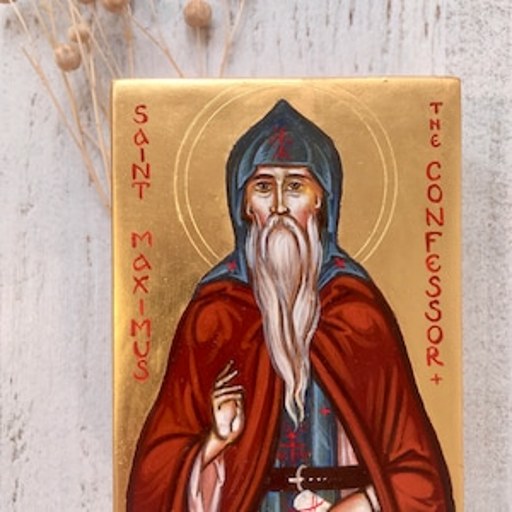
https://www.etsy.com/market/saint_maximus_the_confessor_icon
License: unknown
Confessor Maximus
Saint- Life Span
- d. 662
- Feast Day
- 13 August; 21 January (Eastern Orthodox)
- Gender
- male
- Church
- Catholic
Places
Roles & Family
Biography
Saint Maximus the Confessor (also called Maximus the Theologian) was a Byzantine monk and theologian of the seventh century, remembered above all as the principal defender of the doctrine that Christ possesses two wills, divine and human. The traditional Greek life places his birth in Constantinople, in a family of senatorial rank, toward the end of the sixth century; a hostile Syriac life instead makes him a native of Palestine. Neither account yields a securely attested birth year. He received a thorough education in philosophy and rhetoric and entered imperial service, becoming protoasekretis, or chief secretary, to Emperor Heraclius. In the second decade of the seventh century he left the court for the monastic life, first at the monastery of Philippicus in Chrysopolis, on the Asian shore opposite Constantinople, and later at the monastery of Saint George at Cyzicus.
Persian advances in Asia Minor forced him and other monks to flee. He reached North Africa, probably the region of Carthage, and there formed a close association with Sophronius, later patriarch of Jerusalem. In Africa, and afterward in the West, Maximus became the leading critic of Monothelitism, the teaching—favored at court as a means of reconciling Chalcedonian and non-Chalcedonian Christians—that Christ had only one will. Maximus held that a complete human nature in the incarnate Word must include a genuine human will, distinct from yet always in accord with the divine will. His letters, short treatises, and the Ambigua from this period set out a Christology and a vision of creation ordered toward deification. He supported Pope Martin I and took part in the Lateran Council of 649 in Rome, which condemned Monothelitism and the imperial attempts to forbid further discussion of the question.
The imperial government treated this resistance as politically dangerous. Maximus was arrested, conveyed to Constantinople, and tried. After a first exile in Thrace he was brought back, condemned, and mutilated: his tongue and right hand were cut off so that he could neither speak nor write in defense of his views. He was then banished to Lazica, on the eastern Black Sea coast in the western Caucasus. He died in exile at the fortress of Schemarum on 13 August 662. Because he suffered for the faith without being immediately put to death, he received the title of Confessor.
His surviving works form one of the central corpora of later Greek patristic theology. They include the Ambigua (on difficult passages in Gregory of Nazianzus and Dionysius the Areopagite), the Questions to Thalassius, the Mystagogy on the Divine Liturgy, the Chapters on Love, and numerous letters and opuscula. Maximus synthesized earlier Greek tradition, especially the Cappadocians and Dionysius, into an account of the cosmos as destined for union with God through the Incarnation. Both the Eastern Orthodox and Roman Catholic Churches venerate him as a saint. His death on 13 August is widely observed; the Byzantine calendar also commemorates him on 21 January. Scholarly debate continues over the rival Greek and Syriac accounts of his origins, but his standing as the outstanding seventh-century exponent of dyothelite Christology is not in dispute.