Confessor Maximus is a saint of the Catholic Church (d. 662). Confessor Maximus's feast day is celebrated on 13 August; 21 January (Eastern Orthodox).
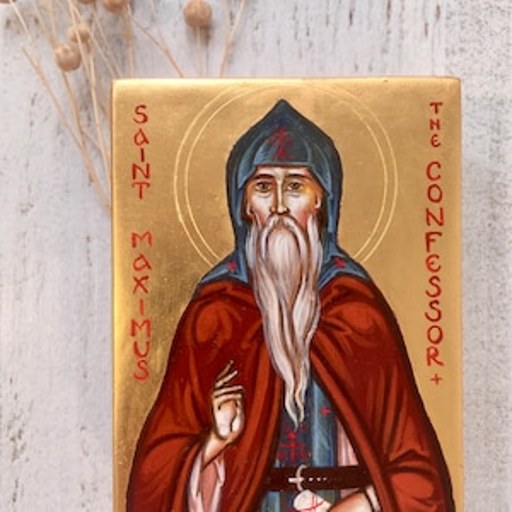
https://www.etsy.com/market/saint_maximus_the_confessor_icon
License: unknown
Confessor Maximus
Saint- Life Span
- d. 662
- Feast Day
- 13 August; 21 January (Eastern Orthodox)
- Gender
- male
- Church
- Catholic
Places
Roles & Family
Biography
Maximus the Confessor, also known as Maximus the Theologian, was a seventh-century Christian monk, ascetic author, and theologian whose resistance to the imperial doctrine of Monothelitism earned him the title of Confessor. A precise year of birth is not recorded in contemporary sources. Later Greek hagiography presents him as a native of Constantinople from a family of senatorial rank who served as a senior secretary in the imperial chancery under Emperor Heraclius before withdrawing to monastic life; a Syriac biography written in hostile Monothelite circles instead places his origins in Palestine and describes him as of humble background. By the 610s he was a monk, first at a monastery in Chrysopolis on the Asian shore of the Bosporus and later near Cyzicus. The Persian invasion of Asia Minor drove him from the region. He eventually reached North Africa, where he lived in monastic communities and came into close association with Sophronius, later patriarch of Jerusalem.
In Africa Maximus became the leading theological opponent of Monothelitism, the teaching that Christ possessed only one will. He maintained that a fully human will in Christ was required by the Incarnation and by the Church’s earlier Christological definitions, and that denial of that will undermined both the integrity of Christ’s humanity and the possibility of human deification. In 645 he held a public disputation at Carthage with Pyrrhus, the deposed patriarch of Constantinople; the record of that debate circulated widely and for a time Pyrrhus recanted. Maximus then went to Rome, where his arguments helped shape the Lateran Council of 649, convened by Pope Martin I, which condemned Monothelitism together with the Ekthesis of Heraclius and the Typos of Constans II.
Imperial authorities treated the council as political defiance as well as theological dissent. Maximus was arrested in 653, taken to Constantinople, and subjected to repeated interrogations over several years. After he refused to accept the Typos, a synod in 662 condemned him, ordered the amputation of his tongue and right hand so that he could neither speak nor write in defense of dyothelite Christology, and exiled him to the fortress of Schemaris in Lazica on the eastern Black Sea. He died there on 13 August 662. The Sixth Ecumenical Council (Constantinople III, 680–681) later endorsed the doctrine of two wills in Christ, thereby vindicating the confession for which he had suffered.
Maximus left a substantial body of writings, among them the Ambigua, the Questions to Thalassius, the Mystagogia on the liturgy, letters, and shorter ascetic and theological treatises. These works set out a comprehensive vision of creation, the Incarnation, and theosis, drawing on Gregory of Nazianzus, Pseudo-Dionysius the Areopagite, and earlier monastic tradition. He has been venerated as a saint in the Eastern Orthodox, Roman Catholic, and Anglican churches from an early date, without a later formal process of canonization of the medieval Western type.