Confessor Nicholas Peregrini is a saint of the Catholic Church (1075 - 1094). Confessor Nicholas Peregrini's feast day is celebrated on 2 June. Confessor Nicholas Peregrini is the patron saint of Trani.
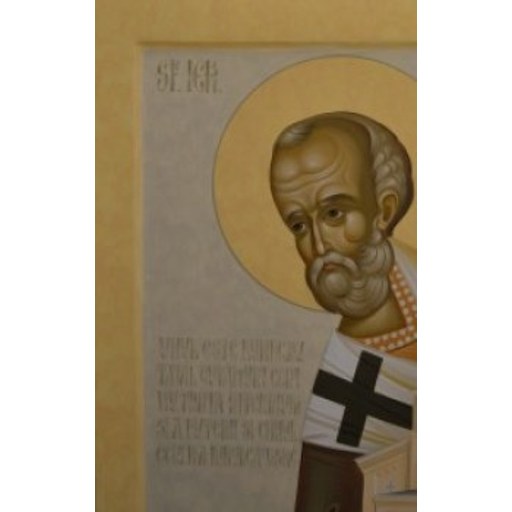
http://byzantinepainting.com/en/saint-nicholas-byzantine-icon-painted/
License: unknown
Confessor Nicholas Peregrini
Saint- Life Span
- 1075 - 1094 (age 19)
- Feast Day
- 2 June
- Gender
- male
- Church
- Catholic
Places
Roles & Family
Patronage
Trani
Canonization
Biography
Nicholas Peregrinus, also known as Nicholas the Pilgrim and in Italian as Nicola Pellegrino, was a Byzantine Greek youth whose short life and itinerant holiness made him the principal patron of the Apulian city of Trani. He was born in 1075 in the village of Steiri in Boeotia, in central Greece, then part of the Byzantine Empire, near the great monastery of Hosios Loukas. According to the near-contemporary Latin vita composed by Adelferio, a cleric of Trani, Nicholas from about the age of eight began to repeat continually the liturgical invocation Kyrie eleison (Lord, have mercy). The habit so alarmed his mother that she placed him in a nearby monastery, where he received a brief formation in Eastern monastic life. He did not remain in the cloister. Leaving the monastery, he took up the existence of a wandering pilgrim and holy fool, travelling through Greece while chanting Kyrie eleison without ceasing, a practice that led some to dismiss him as mad and others to honour him as a salos, the fool-for-Christ of the Byzantine tradition.
In the early 1090s he crossed the Adriatic to southern Italy, which was then under Norman rule and still densely populated by Greek-speaking Christians. He landed in the Salento, passing through Otranto and other towns of Apulia, always repeating his prayer. In some places he was mocked, beaten, or driven away; in others he gathered companions who joined the chant. His arrival in Trani, an important Adriatic port with strong Byzantine connections, marked the last stage of his pilgrimage. There his reputation as a wonder-working stranger grew quickly, and crowds collected around him. Still a very young man, traditionally nineteen years of age, he fell ill and died in Trani on 2 June 1094. Burial and an immediate local cult followed. Miracles were reported at his tomb, and the clergy and people of Trani began to venerate him as a confessor, that is, a saint who had borne witness by a holy life rather than by martyrdom.
The cult received unusually swift papal recognition. Pope Urban II, active in southern Italy in the later 1090s in connection with church reform and the preaching of the First Crusade, authorized the veneration of Nicholas, an act generally dated to 1098 and treated as a canonization. Construction of the great Romanesque cathedral of Trani, dedicated to San Nicola Pellegrino, was begun in the last years of the eleventh century under Archbishop Byzantius; the saint’s relics were enshrined in the crypt, where they remain. Nicholas thus became, and has remained, the patron saint of Trani. His feast is kept on 2 June. The vita by Adelferio, written within a few years of the death, is the principal narrative source and already presents him as a bridge figure between Greek and Latin Christianity at a moment of rising ecclesiastical tension between East and West.
Later medieval and early modern hagiography elaborated the portrait of the boy-pilgrim whose only preaching was the Kyrie, but the core facts—Boetian origin, monastic childhood, wandering recitation of the litany, death at Trani in 1094, and papal confirmation of the cult by Urban II—are those on which the historical tradition rests. He was never a bishop, never married, and belonged to no Western religious order; his identity is that of a Byzantine monastic pilgrim whose relics and cathedral made a Norman-Italian city the centre of his cult.