Confessor Nicolas is a saint of the Catholic Church (793 - 868). Confessor Nicolas's feast day is celebrated on 4 February.
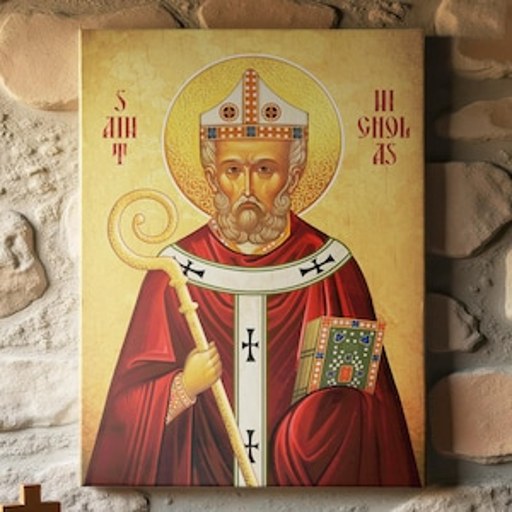
https://etsy.com/market/st_nicholas_icon
License: unknown
Confessor Nicolas
Saint- Life Span
- 793 - 868 (age 75)
- Feast Day
- 4 February
- Gender
- male
- Church
- Catholic
Places
Roles & Family
Religious Information
Biography
Saint Nicholas the Confessor, also known as Nicholas of Studion or Nicholas the Studite, was a ninth-century Byzantine monk and abbot of the Monastery of Stoudios in Constantinople. He was born in 793 in Cydonia (Kydonia) on the island of Crete, then a province of the Byzantine Empire. At about the age of ten he was sent to the capital to live with his uncle Theophanes, a monk of the Stoudios monastery. There he received a monastic education in the rigorous Studite tradition associated with Saint Theodore the Studite, was tonsured, and trained as a copyist in the monastery’s celebrated scriptorium. The Stoudios community was one of the most influential monastic houses of the empire, noted for liturgical reform, manuscript production, and outspoken defense of Orthodox doctrine.
During the second period of Iconoclasm, Nicholas suffered as a confessor of the faith. Under Emperor Leo V the Armenian he refused, together with Theodore and the other Studites, to accept the imperial prohibition of icon veneration. He was imprisoned, subjected to beatings, and sent into exile. Persecution continued in varying degrees under later iconoclast rulers, including Theophilus. Hagiographical accounts present Nicholas as remaining steadfast in the Orthodox teaching on holy images and in loyalty to the Studite rule, even when imperial pressure split or scattered the community. His title “Confessor” reflects this endurance of imprisonment and hardship short of martyrdom for the sake of doctrine.
After the restoration of icons in 843, commonly called the Triumph of Orthodoxy under Empress Theodora, Nicholas returned to Stoudios. Following the death of Abbot Naukratios he was chosen abbot of the monastery, an office he held from the later 840s. He sought to restore Studite discipline and the community’s independence from court interference. Conflict soon arose with Caesar Bardas, uncle and chief minister of Emperor Michael III, over Bardas’s uncanonical cohabitation and related ecclesiastical irregularities. Nicholas’s public opposition led to his deposition from the abbacy and a further period of exile. The episode belongs to the wider ninth-century struggle between Studite ideals of canonical order and the political uses of the church by the imperial household.
In his final years Nicholas was allowed to return to Constantinople and to the Stoudios monastery. He died there on 4 February 868. The Eastern Orthodox Church commemorates him on that date as a confessor and abbot. Knowledge of his life depends chiefly on a Studite vita and related liturgical notices rather than on a large body of independent archival documents; those sources agree on his Cretan origin, his formation under Theodore’s disciples, his sufferings in the iconoclast crisis, his abbacy, and his clash with Bardas. He is remembered as a representative of Studite resistance both to iconoclasm and to later imperial encroachments on monastic and canonical life, and as a link in the transmission of Theodore’s rule into the later ninth century.