Confessor Ninian is a saint of the Catholic Church. Confessor Ninian's feast day is celebrated on 16 September. Confessor Ninian is the patron saint of Galloway;the Diocese of Galloway;Whithorn.
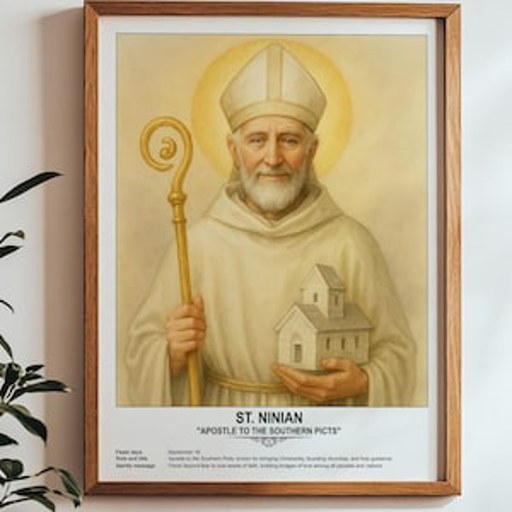
https://www.etsy.com/market/ninian
License: unknown
Confessor Ninian
Saint- Feast Day
- 16 September
- Gender
- male
- Church
- Catholic
Places
Roles & Family
Patronage
Galloway;the Diocese of Galloway;Whithorn
Biography
Saint Ninian, known in early Latin sources as Nynia or Ninnianus and in later vernacular devotion as Ringan, is the missionary bishop traditionally credited with first preaching Christianity among the southern Picts of what is now Scotland. He is commemorated as a bishop and confessor rather than as a martyr. The earliest surviving historical notice of him is in the Ecclesiastical History of the English People, completed by the Venerable Bede in the early eighth century. Bede describes Ninian as a Briton who had been regularly instructed in the faith at Rome. On returning to Britain he established an episcopal centre at a place called Candida Casa, the White House, so named because he built there a church of stone, a manner of construction Bede notes as unusual among the Britons. Bede records that the church was dedicated to Saint Martin of Tours and that from this centre Ninian evangelized the southern Picts, who had previously been in error. Bede locates these labours a long time before the coming of Columba to Iona in the sixth century, thereby placing Ninian in the late fourth or fifth century.
A much fuller narrative was composed in the twelfth century by Ailred of Rievaulx, who stated that he used both Bede and an earlier account written in the British tongue. In Ailred's Life, Ninian is the son of a Christian king ruling in the northern parts of Britain. After a pious youth he travelled to Rome, where he spent many years in study and was consecrated bishop and sent back to preach in his own country. On the journey home he is said to have visited Martin at Tours and to have obtained masons for the stone church he intended to raise. Ailred attributes to him the conversion of local rulers, the instruction of clergy at Candida Casa, journeys among the Picts, and a series of miracles, including healings and the protection of his community. Because Ailred wrote some seven centuries after the period he describes, and because his work follows familiar hagiographical patterns, historians treat its biographical particulars as largely unconfirmed, while still recognizing that it preserves the medieval Scottish understanding of the saint.
The site identified with Candida Casa is Whithorn in Galloway, in south-western Scotland. Excavations there have revealed an early Christian settlement, including inscribed stones. The so-called Latinus stone, generally dated to the fifth century, records a Christian memorial and is among the earliest such monuments in Scotland, supporting the presence of a Latin-using Christian community in the generation to which tradition assigns Ninian. Candida Casa later became a noted monastic school and, in the Middle Ages, the seat of a bishopric and a priory. Ninian's tomb at Whithorn attracted pilgrims from across Scotland and from further afield; Scottish kings, including James IV, visited the shrine. Church dedications to Ninian are numerous in Scotland, especially in the south-west, and they also occur in northern England and in Ireland. A minority of modern scholars have proposed that the name Ninian may derive from a misreading of Uinniau and have suggested an identification with the sixth-century Irish figure Finnian, but this hypothesis remains debated and does not displace the traditional association of the Whithorn founder with the late Roman and immediately post-Roman period.
Ninian's feast day is 16 September, on which he is honoured in the Roman Martyrology and in Scottish calendars, as well as in some Eastern Orthodox commemorations of the saints of the British Isles. He is invoked as patron of Galloway and of the Diocese of Galloway. No contemporary record gives a verified year of birth or of death. Later medieval and early modern writers often assigned his death to 432, a date chosen to keep him in the generation of Martin of Tours, who died in 397, but that year is not attested by Bede or by any fifth-century source. There is likewise no record of a formal canonization by a medieval or modern pope; Ninian belongs to the company of saints whose cult arose in antiquity and was accepted by long veneration. The sources uniformly present him as a monastic bishop and do not record a wife or children. His historical importance lies in the early witness he represents to Christianity in northern Britain beyond the formal frontier of the later Roman Empire, and in the enduring centre of worship and learning that tradition and archaeology alike locate at Whithorn.