Confessor Peter Nolasco is a saint of the Catholic Church (d. 1256). Confessor Peter Nolasco's feast day is celebrated on 28 January. Confessor Peter Nolasco is the patron saint of captives;prisoners;Mercedarian Order.
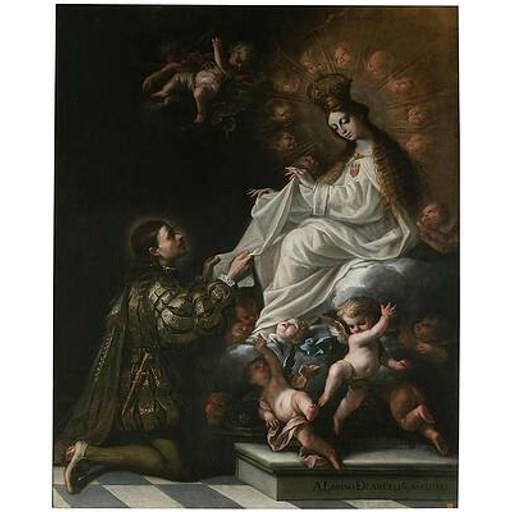
https://fineartamerica.com/art/peter+nolasco
License: unknown
Confessor Peter Nolasco
Saint- Life Span
- d. 1256
- Feast Day
- 28 January
- Gender
- male
- Church
- Catholic
Places
Roles & Family
Religious Information
Patronage
captives;prisoners;Mercedarian Order
Canonization
Biography
Peter Nolasco is venerated in the Catholic Church as a confessor and as the founder of the Order of the Blessed Virgin Mary of Mercy, known as the Mercedarians, a religious institute established in the Crown of Aragon in the early thirteenth century for the redemption of Christian captives. Traditional lives, composed well after his lifetime, place his birth in the late twelfth century at Mas-Saintes-Puelles in Languedoc, with the years 1182 and 1189 both appearing in later sources. Those accounts describe a young man of some means who, confronted with the large numbers of Christians enslaved during warfare between Christian and Muslim powers in Iberia and the western Mediterranean, devoted his resources to their ransom. Surviving thirteenth-century documentation of the Mercedarian institute is considerably fuller than the contemporary record of Nolasco’s personal career, and historians have long noted that particulars of his origins and early years rest on later hagiography rather than on charters or chronicles from his own day.
According to the received tradition, Nolasco made Barcelona his base. In 1218, with the support of King James I of Aragon and the counsel of the Dominican canonist Raymond of Penyafort, he is said to have gathered companions into a brotherhood under the patronage of the Virgin Mary of Mercy. The new institute combined religious observance with a distinctive fourth vow: members bound themselves, if necessary, to remain as hostages in order to free captives whose Christian faith was in danger. Papal confirmation followed in the 1230s under Gregory IX. Houses were founded in Catalonia, Aragon, and other parts of the western Mediterranean, and the Mercedarians organized collections and expeditions to negotiate the release of prisoners from Muslim authorities in Iberia and North Africa.
Nolasco is remembered as the first master or commander of the order, directing its redemptive missions during a period of intense frontier conflict and captive-taking. The Mercedarians belonged to a broader thirteenth-century movement of ransoming institutes, of which the Trinitarians were another prominent example. Devotion to Our Lady of Mercy shaped the order’s habit, liturgy, and public identity. Traditional sources state that Nolasco died in Barcelona on 6 May, the year being given as 1256 or, in some versions, 1258, and that he was buried in the church of his community there. He is not recorded as having married or as having had children; his life as presented in the tradition is that of a religious founder bound by the vows of his institute.
Veneration of Peter Nolasco developed within the Mercedarian Order and in Catalonia. He was canonized by Pope Urban VIII in 1628. For centuries his feast was kept on 6 May, the traditional date of his death; it was later assigned to 28 January in the General Roman Calendar. After the calendar reform of 1969 the memorial ceased to be obligatory in the universal calendar, but 28 January remains the date in the Roman Martyrology, and the Mercedarians and various local churches continue to honor him. He is invoked as a patron of captives and of prisoners and as founder of the Mercedarians. In art he is commonly shown receiving the white habit or scapular from the Virgin Mary, or breaking the chains of enslaved Christians.