Confessor Pope Eusebius is a saint of the Catholic Church (d. 309). Confessor Pope Eusebius's feast day is celebrated on 26 September.
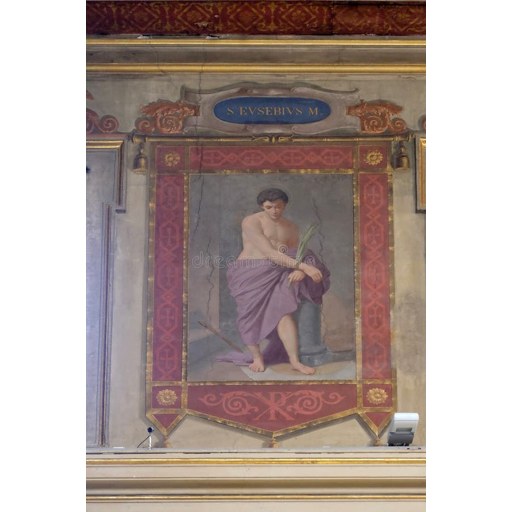
https://dreamstime.com/photos-images/eusebius-church.html
License: unknown
Confessor Pope Eusebius
Saint- Life Span
- d. 309
- Feast Day
- 26 September
- Gender
- male
- Church
- Catholic
Places
Roles & Family
Biography
Pope Saint Eusebius was bishop of Rome for only a few months in the early fourth century, when the Christian community of the city was still recovering from the Great Persecution under Diocletian and Galerius and was sharply divided over how to treat those who had lapsed from the faith. The Liberian Catalogue, one of the earliest surviving lists of the bishops of Rome, assigns him a pontificate from 18 April 309 to 17 August 309. Some later reconstructions of papal chronology prefer 310 for both the beginning and the end of his reign. He succeeded Pope Marcellus I, whose own short episcopate had already been marked by conflict over the same disciplinary questions. Virtually nothing is known of Eusebius before his election. The Liber Pontificalis, a compilation of papal biographies whose notices for the third and early fourth centuries mix genuine tradition with later legend, describes him as a Greek by birth, but that statement cannot be independently confirmed and should be treated with caution.
The central issue of his episcopate was the status of the lapsi, Christians who had denied the faith, handed over sacred books, or otherwise complied with imperial edicts during the persecution. Two tendencies stood in opposition. One, represented by Eusebius, insisted that reconciliation with the Church required a period of public penance, in continuity with practice defended in the previous century by figures such as Cyprian of Carthage. The other, associated in the Roman sources with a man named Heraclius, demanded that the lapsed be restored at once to communion without such a process. The disagreement was not merely academic; it produced factions and public disturbances in Rome itself. The troubles that had already afflicted Marcellus continued under his successor and became severe enough to draw the attention of the civil power.
Emperor Maxentius, who held Italy and North Africa from 306 to 312, was not a Christian, yet he had relaxed persecution in his territories and had no interest in seeing the capital disrupted by intra-Christian conflict. He therefore banished both Eusebius and Heraclius to Sicily. Eusebius died on that island, still in exile, on 17 August of 309 or possibly 310. Because he was not executed but died as a result of banishment endured for his defense of ecclesiastical discipline, later tradition honored him as a confessor rather than as a martyr in the narrow sense of one put to death. In the later fourth century Pope Damasus I composed a verse epitaph for him, substantial fragments of which were recovered in the nineteenth century in the Catacomb of Callixtus by Giovanni Battista de Rossi. The poem recalls the strife that arose because the pope had forbidden the lapsed to be received back without penance, the resulting tumult, the expulsion of the bishop, and his death far from Rome; Damasus uses language that presents Eusebius’s sufferings as a form of martyrdom.
After his death the body of Eusebius was translated from Sicily to Rome and laid to rest in the cemetery of Callistus on the Appian Way, the burial place of a number of third- and fourth-century bishops of Rome. He has been venerated as a saint from early times. In the traditional General Roman Calendar his feast was observed on 26 September under the title of pope and confessor. The contemporary Roman Martyrology commemorates him on 17 August, the date associated with his death, and notes his exile under Maxentius and the subsequent return of his remains to the Callistan cemetery. No reliable ancient source records a wife or children, and he is not known to have belonged to any later religious order. Specific patronages of places, professions, or causes are not securely attached to his name in the later history of devotion. His brief pontificate remains important chiefly as evidence of the severe internal strains that accompanied the Church’s emergence from the last great pagan persecution of the Roman Empire.