Confessor Pope Innocent is a saint of the Catholic Church (d. 417). Confessor Pope Innocent's feast day is celebrated on 12 March.
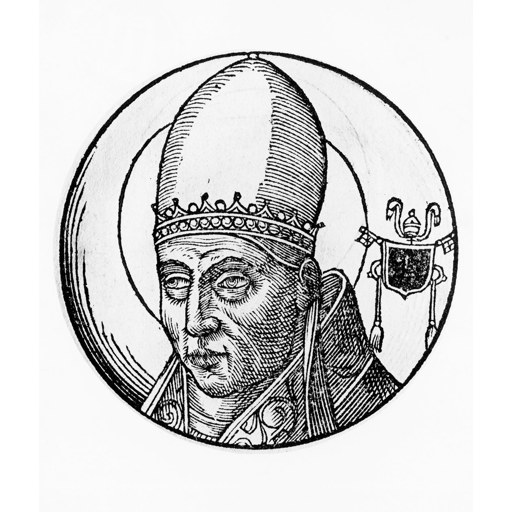
https://meisterdrucke.uk/fine-art-prints/Blaise-Nicolas-Le-Sueur/1079975/Portrait-of-Saint-Innocent-I,-40th-Pope-of-Catholic-Church.html
License: unknown
Confessor Pope Innocent
Saint- Life Span
- d. 417
- Feast Day
- 12 March
- Gender
- male
- Church
- Catholic
Places
Roles & Family
Biography
Pope Innocent I, venerated as a confessor-saint in both the Latin and Eastern churches, was Bishop of Rome from 401 until his death in 417. The Liber Pontificalis, the principal early papal biographical compilation, describes him as a native of Albano (Albanensis) in Latium and the son of a man named Innocentius. A later tradition, not universally accepted by historians, identified him as the son of his predecessor Anastasius I; the safer reading of the sources is simply that he belonged to the Roman clerical world of the late fourth and early fifth centuries. His birth year is not recorded in any reliable source. He succeeded Anastasius I and governed the Roman church during one of the most politically and spiritually unsettled decades of late antiquity, when the Western imperial court had already withdrawn to Ravenna and the authority of the old capital was under severe strain.
The defining public catastrophe of his pontificate was the sack of Rome by the Visigoths under Alaric in August 410. Innocent was not in the city at the time: he had gone to Ravenna to appeal to the emperor Honorius for military aid against the Gothic threat. He returned after the sack to a traumatized community. Contemporary and near-contemporary writers, including Augustine in North Africa, treated the event as a world-historical shock; Innocent’s own surviving correspondence does not dwell on it at length, but his subsequent activity shows a bishop attempting to restore discipline, charity, and the prestige of the Roman see. He maintained an extensive correspondence with churches in Italy, Gaul, Spain, Illyricum, and Africa, and he consistently presented Rome as the court of appeal in major disciplinary and doctrinal cases. A well-known letter to Decentius, bishop of Gubbio, sets out Roman liturgical customs (including the position of the kiss of peace, the recitation of names, and confirmation) as a model for other churches. Another letter, to Exuperius of Toulouse, discusses the canon of Scripture and the treatment of lapsed or irregular clergy.
Doctrinally, Innocent is remembered above all for his intervention in the Pelagian controversy and for his support of John Chrysostom. After the African bishops, led by Augustine and others, condemned Pelagius and Caelestius, they sought Roman confirmation. Innocent replied in 416–417, endorsing the African decisions and excluding Pelagius and Caelestius from communion until they should recant. These letters were later cited as early evidence of Roman involvement in a dispute that would continue after his death under Zosimus. Independently, Innocent had already taken the part of John Chrysostom after the latter’s deposition and exile from Constantinople, refusing to recognize the intruded succession and writing on Chrysostom’s behalf to the imperial court and to the Eastern bishops. The episode illustrates both his sense of Roman responsibility for other major sees and the practical limits of that influence in the East. He also asserted Roman rights over the churches of Eastern Illyricum, which were ecclesiastically contested between Rome and Constantinople.
Innocent died in Rome on 12 March 417 and, according to the Liber Pontificalis, was buried in the cemetery of Pontianus on the Via Portuensis. He was honoured as a saint from an early date, without a formal process of canonization of the later medieval type. In the Eastern Orthodox calendar he is commemorated on 12 March, the date of his death; in the Tridentine Roman calendar his feast was kept on 28 July, together with Saints Nazarius, Celsus, and Victor I, a grouping later dropped from the General Roman Calendar. He is not associated in the sources with a religious order, a recorded marriage, or children, and no well-documented list of specific patronages attaches to his name. His historical importance lies in the combination of a strong theory of Roman primacy, active correspondence across the Mediterranean, and a pontificate lived through the Gothic sack and the opening phase of the Pelagian crisis.