Confessor Simeon is a saint of the Catholic Church.
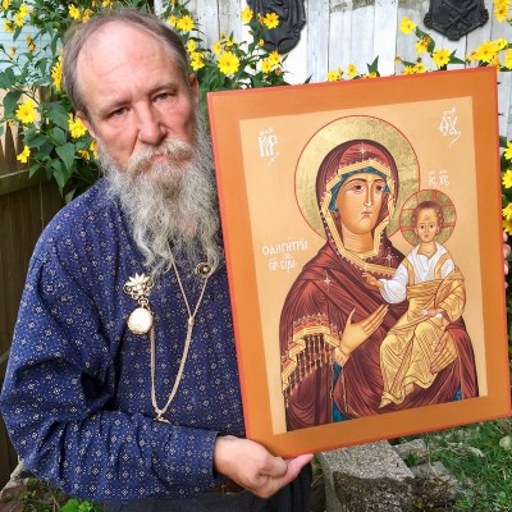
https://pittsburghorbit.com/2017/12/03/all-rite-now-simeon-larivonovoff-painter-of-icons
License: unknown
Confessor Simeon
Saint- Gender
- male
- Church
- Catholic
Biography
The designation Confessor Simeon (also spelled Symeon) does not uniquely identify a single historical person in the Christian hagiographical record. Confessor is an ecclesiastical title, used especially in the Eastern churches and in older Western martyrologies, for a saint who suffered for the faith or who was commemorated for outstanding holiness without dying a violent martyr’s death. Several bishops, monks, and recluses named Simeon or Symeon have been so titled, and they belong to different centuries and regions. In the absence of a feast day, see, monastery, or other disambiguating detail, the principal candidates can only be described separately, and no single set of biographical dates or places can be assigned with confidence.
One of the better-documented Western figures sometimes listed simply as Simeon the Confessor is the recluse of Trier, a Greek-speaking monk associated with Syracuse in Sicily who ended his life in the German city of Trier in the eleventh century. Medieval accounts relate that he was of Greek parentage, spent time in Constantinople and in the monasteries of the Holy Land, including Sinai, and later accompanied Archbishop Poppo of Trier from Jerusalem to the Rhineland. There he took up the life of an enclosed recluse in a chamber of the Roman Porta Nigra. He died in Trier on 1 June in the year 1035 and was buried at the gate, which was subsequently adapted as a church in his honor. Later tradition regards him as having been recognized as a saint by the papacy in the 1040s. His cult is local to Trier and the surrounding region; a precise year of birth is not preserved in the early sources.
In the Christian East a number of other holy men named Symeon received the title of confessor. Among hierarchs, Simeon bar Sabbae, catholicos of the Church of the East at Ctesiphon in the fourth century, is sometimes remembered in connection with confession of the faith, though the surviving acts present him as a martyr beheaded under Shapur II rather than as a confessor who survived his sufferings. Later Byzantine and Slavic calendars include monastic confessors named Symeon, some of them associated with the iconoclast controversy of the eighth and ninth centuries, when monks who defended the veneration of icons were imprisoned, exiled, or otherwise penalized without always being put to death. The surviving notices for these figures are often brief, giving a feast day and a general indication of monastic profession but little that would support a full biography or a verified year of birth.
A further Eastern figure of great fame is Symeon the God-receiver, the aged righteous man of Jerusalem who, according to the Gospel of Luke, took the infant Jesus in his arms in the Temple. He is commemorated in both East and West, commonly on 3 February in the Byzantine rite and on 2 or 3 February in some Western uses, but he is not ordinarily styled Confessor in the technical sense, and no historical year of birth or death can be established for him. Other well-known Symeons—Symeon Stylites the Elder of the fifth century near Aleppo, Symeon Stylites the Younger of the Wondrous Mountain in the sixth century, Symeon the New Theologian of the late tenth and early eleventh centuries, and Symeon of Emesa the Fool for Christ—have their own distinct titles and cults and should not be conflated with an otherwise unspecified Confessor Simeon.
Because the name and title together remain ambiguous, fields that require a unique identity—year of birth, places of birth and death, burial, religious order, patronage, and the names of those who beatified or canonized the saint—cannot be filled from reliable sources without further specification. Gender may reasonably be given as male, as Simeon is a masculine biblical name borne by these saints. Claims of marriage, children, papal or patriarchal office, or a single feast day would be guesswork and are therefore omitted. Anyone seeking a particular Confessor Simeon should supply a feast date, a city or monastery, or a century so that the correct dossier can be identified.