Confessor Simplicius is a saint of the Catholic Church (d. 483). Confessor Simplicius's feast day is celebrated on 10 March.
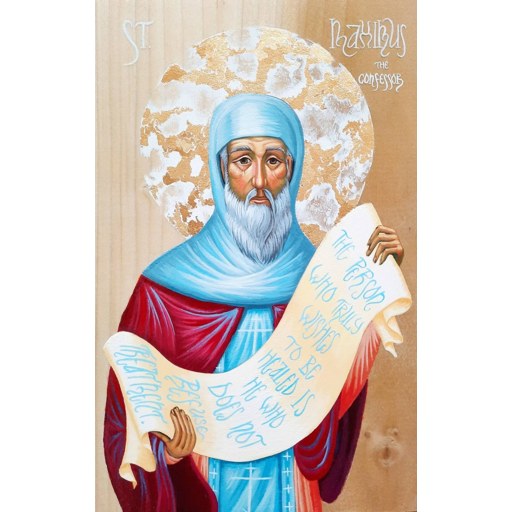
https://www.etsy.com/listing/1294340881/partly-hand-paintedgilded-st-maximus-the
License: unknown
Confessor Simplicius
Saint- Life Span
- d. 483
- Feast Day
- 10 March
- Gender
- male
- Church
- Catholic
Places
Roles & Family
Biography
Pope Saint Simplicius, styled in the martyrologies as pope and confessor, was a native of Tivoli (ancient Tibur) in Latium, the son of a man named Castinus. No surviving source records the year of his birth, and it must not be confused with the year of his accession. He belonged to the Roman clergy and was elected bishop of Rome in 468, succeeding Pope Hilarius. His pontificate fell in the last years of the Western Roman Empire. In 476 the Germanic commander Odoacer deposed the boy-emperor Romulus Augustulus and assumed power in Italy. Odoacer, though an Arian, generally left the Catholic Church in Italy unmolested, and Simplicius continued to govern the Roman see and its patrimonies through a period of political collapse.
The chief theological labor of his reign was the defense of the Council of Chalcedon (451) and of the Tome of Pope Leo I against Monophysitism. After the death of the Emperor Leo I, the Eastern court under Zeno and Patriarch Acacius of Constantinople favored policies that weakened Chalcedonian orthodoxy. Simplicius wrote repeatedly to the East insisting on the authority of Chalcedon. He supported the Chalcedonian patriarch of Alexandria, Timothy Salofaciolus, and protested the installation of Monophysite bishops in Eastern sees. When Zeno issued the Henotikon in 482, a formula of union that passed over Chalcedon in silence, Simplicius refused to accept it. These disputes prepared the ground for the Acacian schism, which opened shortly after his death under his successor Felix III.
In Rome, Simplicius was an active organizer of worship and church fabric. He dedicated the church of San Stefano Rotondo on the Caelian Hill in honor of the protomartyr Stephen, and he established or restored churches in honor of the apostles Andrew and Bartholomew. He assigned the weekly liturgical service of the great basilicas of Saint Peter, Saint Paul, and Saint Lawrence to a rotation of priests drawn from the Roman tituli, so that those churches would not lack regular pastoral care. He also attended to the administration of ecclesiastical property in a time of insecurity.
Simplicius died in Rome on 10 March 483 and was buried in the portico of the Constantinian basilica of Saint Peter on the Vatican hill. He is venerated as a confessor, that is, as a saint who bore public witness to orthodox faith and to the claims of the Roman see without undergoing martyrdom. In the General Roman Calendar his feast is kept on 10 March, the day of his death; an older Roman observance fell on 2 March. The principal sources for his life are the Liber Pontificalis, a small body of letters, and the records of the Eastern Christological controversies. Details of his early career, any family he may have had, and many ordinary acts of his pontificate are not preserved.