Confessor Taurinus is a saint of the Catholic Church. Confessor Taurinus's feast day is celebrated on 11 August. Confessor Taurinus is the patron saint of Évreux;Diocese of Évreux.
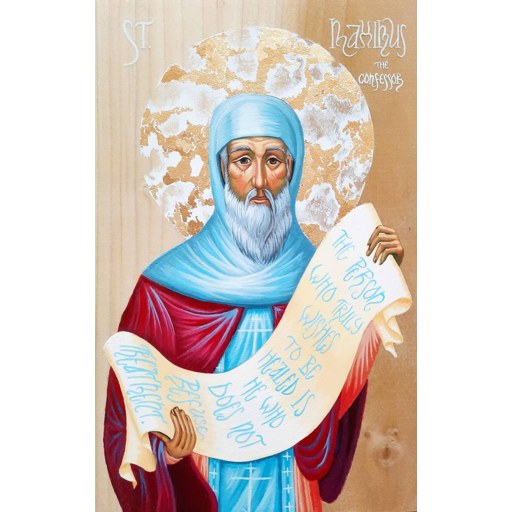
https://etsy.com/listing/1294340881/partly-hand-paintedgilded-st-maximus-the
License: unknown
Confessor Taurinus
Saint- Feast Day
- 11 August
- Gender
- male
- Church
- Catholic
Places
Roles & Family
Patronage
Évreux;Diocese of Évreux
Biography
Saint Taurinus, also known as Taurin, is venerated in the Latin Church as a confessor and as the traditional first bishop of Évreux in Normandy. His feast is kept on 11 August, the date assigned to him in the Roman Martyrology, which commemorates him as bishop and confessor at Évreux in Gaul. Almost nothing about his life can be verified from sources contemporary with the late Roman or early Merovingian period. The chief narrative of his career is the Vita Taurini, a Latin hagiographical text written in the ninth century. That vita is widely regarded by historians as legendary: it places Taurinus in the apostolic age, claiming that Pope Clement I sent him from Rome to evangelize the pagans of the Évreux region, and it attributes to him a series of miracles, conversions, and confrontations with local cults. Such first-century dating is anachronistic for a see in northern Gaul and belongs to a common medieval pattern of tracing diocesan origins to the apostolic era.
If Taurinus was a historical bishop, a fourth- or fifth-century context is more plausible, corresponding to the period when episcopal organization was taking shape in that part of Gaul. No inscription, conciliar list, or other independent document from that era, however, names him, so even his existence as an individual remains a matter of later tradition rather than of contemporary record. The see of Évreux itself is securely attested only later. Medieval devotion to Taurinus was nonetheless strong. A Benedictine monastery at Évreux, the Abbey of Saint-Taurin, was dedicated to him and became the principal centre of his cult. The abbey claimed to possess his relics, and in the thirteenth century a richly decorated châsse was made to house them; the reliquary survives and illustrates scenes drawn from the legendary vita.
Taurinus is honoured as patron of the city and diocese of Évreux. He is not described in the liturgical sources as a martyr, but as a confessor, that is, a holy bishop who died in peace. No reliable evidence survives concerning his family, the place or date of his birth, or the circumstances of his death beyond the local tradition that associates him with Évreux. He is not known to have belonged to a religious order, nor did he hold the offices of pope or patriarch. Details of marriage or children are unrecorded.
Later liturgical books and local histories of Normandy repeated and embellished the ninth-century legend, so that Taurinus appears in numerous martyrologies and in the traditional lists of the bishops of Évreux as the founder of the see. Critical scholarship since the nineteenth century has distinguished the cult, which is medieval and well documented, from the biographical particulars, which are not. The name Taurinus itself is Latin and is attested elsewhere in the Roman world; it does not by itself prove a Roman origin. In the absence of archaeological or documentary confirmation, the most that can be said with confidence is that a saint named Taurinus was honoured at Évreux from the early Middle Ages as the first bishop of the city, that his feast was fixed on 11 August, and that his relics and patronage remained important to the local church throughout the medieval and early modern periods.