Conon is a saint of the Catholic Church. Conon's feast day is celebrated on 5 March.
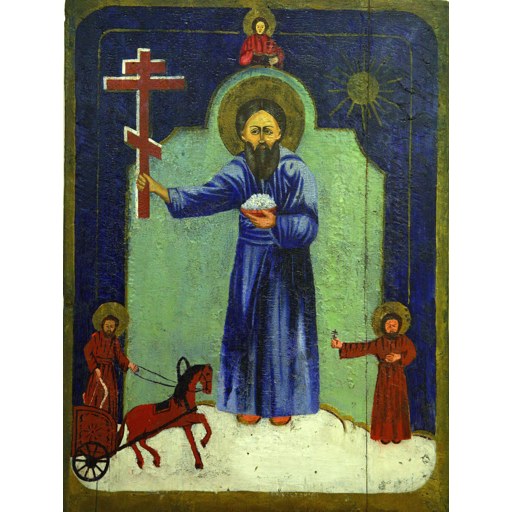
Anonymous Russian icon painter (before 1917)Public domain image (according to PD-Russia-expired)
License: Public domain
Conon
Saint- Feast Day
- 5 March
- Gender
- male
- Church
- Catholic
Places
Roles & Family
Biography
Conon of Perga, also known in Eastern Christian tradition as Conon the Gardener, is a Christian martyr associated with the Roman province of Pamphylia in Asia Minor in the mid-third century. Almost nothing about him can be confirmed from contemporary non-hagiographical sources. The surviving picture of his life and death comes from later Greek passions, synaxaria, and entries in Eastern and Western martyrologies. These texts place his martyrdom in the persecution that followed the edicts of the emperor Decius (reigned 249–251), when Christians throughout the empire were required to sacrifice to the traditional gods and obtain certificates of compliance.
According to the traditional accounts, Conon was a native of Nazareth in Galilee who later lived in Magydos, a coastal city of Pamphylia not far from Perga. He earned his living as a gardener and is portrayed as a simple, unlettered layman who had been a Christian from childhood. When the Decian measures were enforced locally, he was denounced, arrested, and brought before the provincial governor. He refused to offer sacrifice and openly confessed Christ. The governor then subjected him to torture. The most distinctive episode in the legend is that nails were driven through Conon’s feet and he was forced to run ahead of the governor’s chariot until he collapsed from pain, exhaustion, and loss of blood; he died of these injuries, though some recensions add that he was beheaded.
His cult is ancient and belongs to the pre-congregational period; there was no later papal canonization or beatification process. He is commemorated on 5 March in the calendars of the Eastern Orthodox Church, frequently on the same day as another martyr of the same name, Conon of Isauria, whose legend likewise links him with Nazareth. Hagiographical scholars have long noted that the two figures may have been partially conflated in the course of transmission. In the Latin West he appears in the Roman Martyrology in connection with Magydos in Pamphylia. No reliable evidence survives concerning a spouse, children, monastic profession, or the precise place of his burial, and no historically verified year of birth or death is known.