Conrad of Bavaria is a saint of the Catholic Church (d. 1154). Conrad of Bavaria's feast day is celebrated on 9 February. Conrad of Bavaria is the patron saint of Molfetta.
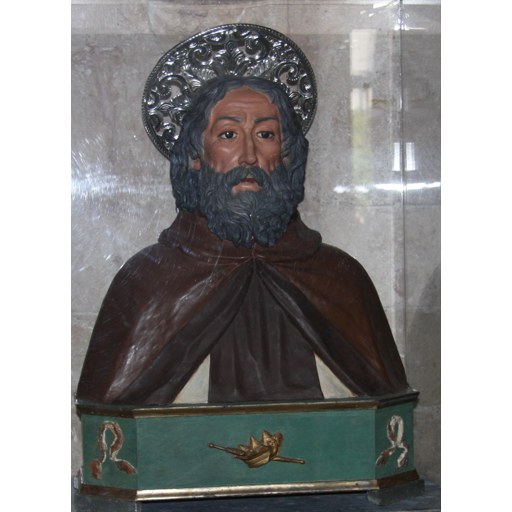
Pramzan
License: CC BY-SA 3.0
Conrad of Bavaria
Saint- Life Span
- d. 1154
- Feast Day
- 9 February
- Gender
- male
- Church
- Catholic
Places
Relics & Where to Venerate
Location unknown
The bodily remains of Conrad of Bavaria are a first-class relic. Venerated at Molfetta.
Roles & Family
Religious Information
Patronage
Molfetta
Biography
Conrad of Bavaria was a twelfth-century Cistercian monk of the House of Welf, son of Henry IX, Duke of Bavaria, known as Henry the Black, and of Wulfhild of Saxony, daughter of Magnus Billung, Duke of Saxony. Through this parentage he belonged to one of the leading princely families of the Holy Roman Empire. His brothers included Henry the Proud, later duke of Bavaria and Saxony, and Welf VI; his sister Judith of Bavaria married Frederick II, Duke of Swabia, and was the mother of the future emperor Frederick I Barbarossa, making Conrad that emperor’s uncle. Later tradition places his birth at Ravensburg in Swabia, in Welf territory, around the beginning of the twelfth century; the epithet “of Bavaria” reflects his father’s ducal title rather than a precisely documented birthplace in Bavaria proper. As a younger son of a great house he was directed toward an ecclesiastical career rather than territorial rule.
He received an education at Cologne, then a major centre of learning in the German kingdom. Attracted by the fame of Bernard of Clairvaux and the Cistercian reform, he abandoned the prospect of high secular or prelatical office and entered the abbey of Clairvaux in Burgundy, where he became a monk under Bernard’s direction. The early Cistercians followed a strict interpretation of the Rule of Saint Benedict, with emphasis on poverty, manual labour, and the liturgical office, and Conrad’s vocation belongs to the well-attested pattern of high nobles who joined the White Monks in the first half of the twelfth century. Contemporary narrative sources for his years at Clairvaux are thin; the outline of his monastic life is preserved mainly in later hagiography and in the Roman Martyrology’s brief notice.
Later in life Conrad went on pilgrimage to the Holy Land. The length and character of his stay in Palestine are not recorded in detail by twelfth-century chroniclers. Later tradition presents him as living there in penitence, in a monastic or eremitical setting, during the decades when a Latin presence already existed in the East in the aftermath of the First Crusade and around the time of the Second Crusade. On the return journey to the West he landed in Apulia, in southern Italy, then part of the Norman Kingdom of Sicily. He fell ill and died at Modugno, near Bari, on 17 March 1154. He was first buried locally, at the church of Santa Maria di Modugno, and reports of miracles at the tomb soon gave rise to a cult.
Devotion to Conrad became especially strong in the Apulian coastal city of Molfetta, which adopted him as its principal patron. His relics were later translated there and are venerated in the cathedral that bears his name, the Cathedral of San Corrado. The Roman Martyrology commemorates him on 9 February, recalling him as a monk, a son of the duke of Bavaria, a disciple of Saint Bernard at Clairvaux, and a pilgrim who died at Modugno on his return from the Holy Land. He is honoured as a saint or blessed in the Catholic Church, above all in southern Italy. A formal papal canonization in the later juridical sense is not clearly documented; his cult is of the medieval local type subsequently received into the wider martyrology. The surviving portrait of his life is therefore a combination of a secure noble genealogy, a Cistercian and pilgrim vocation, a well-attested death in Apulia, and a durable civic cult at Molfetta, with many lesser anecdotal details depending on later hagiographical tradition rather than on abundant contemporary record.