Constance of Hungary, Queen of Galicia is a saint of the Catholic Church.
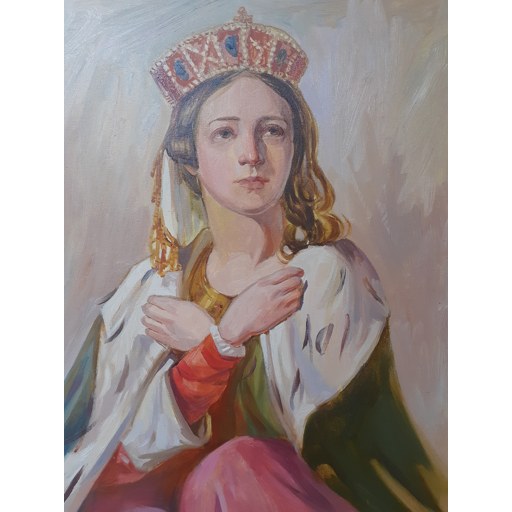
Markverona
License: CC BY-SA 4.0
Constance of Hungary, Queen of Galicia
Saint- Gender
- female
- Church
- Catholic
Places
Roles & Family
Religious Information
Biography
Constance of Hungary was a thirteenth-century princess of the Árpád dynasty, a daughter of King Béla IV of Hungary and Queen Maria Laskarina. Through her father she belonged to the Hungarian royal house that had ruled since the eleventh century; through her mother she was a granddaughter of Theodore I Laskaris, emperor of Nicaea. She belonged to a large sibling group whose marriages and religious vocations were used to restore Hungarian influence after the Mongol invasion of 1241–1242. Several of her sisters became famous in religion and were later venerated, among them Saint Kinga of Poland, Saint Margaret of Hungary, and Blessed Yolanda of Poland. Constance’s own career was that of a dynastic bride sent to the court of Galicia-Volhynia rather than to the cloister. Neither a precise year of birth nor a contemporary narrative of her childhood survives; she is known from later genealogical and chronicle tradition as a daughter of Béla IV given in marriage to the Romanovych house of southwestern Rus’.
The marriage belonged to Béla IV’s policy of surrounding the recovered kingdom with allied dynasties and of supporting Daniel Romanovych of Galicia, the leading prince of that region. Daniel sought Western diplomatic and military backing against the Golden Horde and against local rivals, and in the mid-thirteenth century he accepted a royal crown in connection with negotiations involving the papacy. Constance was married to Daniel’s son Lev Danylovych, known in Latin and Western historiography as Leo. The union is generally placed in the middle decades of the thirteenth century, after the Mongol invasion and in the setting of Hungarian–Galician cooperation. By it she became a princess of Galicia–Volhynia and, after Daniel’s death in the 1260s and Lev’s rise to dominance, queen consort of that realm. Lev’s lands included Halych, Przemyśl, and, increasingly, the new center of Lviv, a town associated with his name and with the later medieval kingdom of Ruthenia. The marriage thus tied the Árpád monarchy to the principal Rus’ kingdom on Hungary’s north-eastern frontier.
Documentary evidence for Constance’s personal life, patronage, and political agency is sparse, as is common for consorts in thirteenth-century Hungarian and Rus’ sources. She is recorded as the mother of children who continued the Romanovych line. Her son Yuri, known as George I of Galicia, later ruled as king of Galicia–Volhynia and carried the family’s marriages into the Piast and other Central European houses. Daughters attributed to the couple include a child who entered the religious life and Anastasia, who married Ziemomysł of Inowrocław in Kuyavia. Constance therefore stood at the junction of Árpád, Romanovych, and Piast kinship networks that structured politics from the Danube toward the Dniester. As a Latin-rite Catholic at a court whose elite remained largely Orthodox, she also embodied the incomplete rapprochement between Rome and the Galician church in her father-in-law’s generation, though that union policy did not produce a lasting change of rite in the principality.
The date and place of her death are not established with certainty, and her burial place is not securely identified. She does not appear among the canonized or beatified members of the Árpád family, and no traditional feast day or patronage is attached to her name. Her memory is preserved chiefly in genealogies and in the dynastic history of Galicia–Volhynia, where she figures as the Hungarian wife of Lev I and as the mother of King Yuri I. That role, however poorly illuminated by narrative sources, had lasting consequence: it bound the restored Hungarian monarchy to the Romanovych state and helped produce a generation of Galician-Volhynian rulers who remained entangled with Polish and Hungarian affairs until the inheritance of the realm passed into other hands in the fourteenth century.