Constantine the Great is a saint of the Catholic Church (272 - 337). Constantine the Great's feast day is celebrated on 21 May.
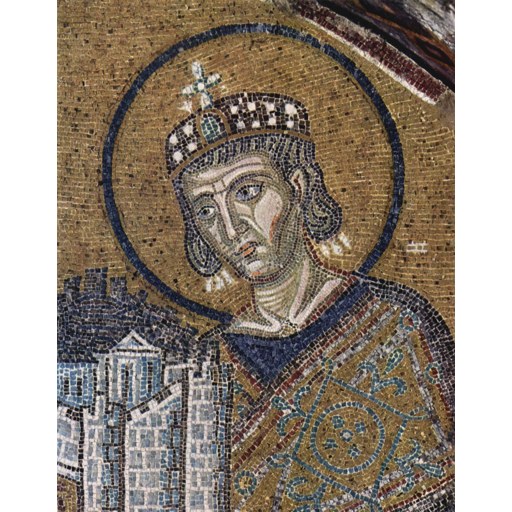
Byzantine mosaicist, ca. 1000
License: Public domain
Constantine the Great
Saint- Life Span
- 272 - 337 (age 65)
- Feast Day
- 21 May
- Gender
- male
- Church
- Catholic
Places
Relics & Where to Venerate
Location unknown
The bodily remains of Constantine the Great are a first-class relic. Venerated at Church of the Holy Apostles.
Roles & Family
Religious Information
Biography
Constantine I, known as Constantine the Great, was Roman emperor from 306 until his death in 337 and the first Roman ruler to convert to Christianity. He was born at Naissus in Moesia Superior (present-day Niš in Serbia), the son of the officer and later tetrarch Constantius and of Helena. His early career was spent at the eastern court of Diocletian and Galerius, where he served as a military tribune and was in effect a hostage guaranteeing his father's loyalty. After Constantius died at York in 306, the British and Gallic armies proclaimed Constantine emperor, an act that disrupted the Tetrarchic system and led to nearly two decades of intermittent civil war.
In 312 Constantine invaded Italy and defeated Maxentius at the Milvian Bridge. Christian writers of the fourth century, notably Lactantius and Eusebius of Caesarea, reported that Constantine had been granted a heavenly sign—described variously as a cross or the chi-rho monogram—and had ordered his troops to fight under that emblem. The following year Constantine and Licinius agreed at Milan on a policy of religious toleration that restored confiscated church property and allowed Christians to worship openly. After further conflict Constantine overthrew Licinius in 324 and became master of the entire empire.
As sole emperor he founded a new capital at Byzantium, dedicated in 330 as Constantinople, and reorganized imperial administration, taxation, and the army. In 325 he convened the Council of Nicaea, the first ecumenical council, which condemned Arianism and issued a creed affirming that the Son is of one substance with the Father. Constantine endowed basilicas in Rome, the Holy Land, and other cities, granted the clergy legal immunities, and increasingly identified the prosperity of the empire with the favor of the Christian God, while still holding the pagan office of pontifex maximus and issuing coinage that for some years retained traditional solar imagery.
Constantine's domestic life included marriage to Fausta, daughter of Maximian, and an earlier union with Minervina that produced his eldest son Crispus. His sons Constantine II, Constantius II, and Constans later divided the empire. In 326 Crispus and Fausta were put to death in an episode whose motives are still debated by historians. Late in his final illness Constantine received baptism from Bishop Eusebius of Nicomedia and died on 22 May 337 at a suburban villa near Nicomedia. He was interred in the Church of the Holy Apostles at Constantinople. Eastern Christian churches honor him as a saint and Equal to the Apostles, celebrating his feast with that of his mother Helena on 21 May. His reign established the political framework within which Christianity became the dominant religion of the Roman world.