Constantius is a saint of the Catholic Church.
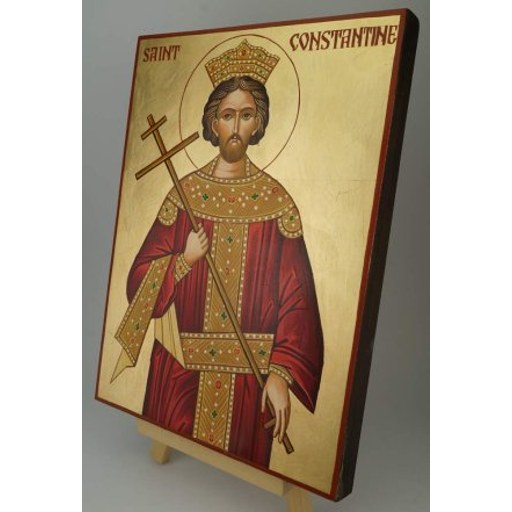
https://www.blessedmart.com/shop/hand-painted-icons/male-saints-icons/saint-constantine-icon/
License: unknown
Constantius
Saint- Gender
- male
- Church
- Catholic
Biography
The Latin name Constantius (from constans, steadfast) was common in the later Roman Empire and in the churches that inherited Roman naming. Emperors, soldiers, bishops, priests, and local martyrs all appear under it in chronicles, martyrologies, and later legendaries. This query gives only the name Constantius, with no Wikidata item, encyclopedia article, see, century, or feast to fix a single person. Hagiographical dictionaries list several distinct saints and blesseds of the name; late-antique literary history adds at least one important priest-author; political history adds imperial Constantii. Merging them would invent dates and cults. Fields that need one verified fact are therefore left blank.
In fifth-century Gaul a priest named Constantius of Lyon (Lugdunum) is securely attested as a writer and as a member of the Christian senatorial aristocracy. Sidonius Apollinaris wrote to him and praised his learning. At the request of Patiens, bishop of Lyon, Constantius composed the Life of Germanus of Auxerre, the principal early life of that bishop and an important source for fifth-century Gaul and Britain. The Vita belongs to the later fifth century (often placed in the 470s or 480s on contextual grounds), but Constantius’s own birth and death years are not stated in the work or in Sidonius. He is not known to have been Bishop of Rome or patriarch of an Eastern see. A formal liturgical cult of Constantius himself, comparable to that of Germanus, is not established in the major Roman or Byzantine calendars. No reliable source records a spouse or children.
Italian local calendars preserve other men of the name. San Costanzo of Perugia is venerated as an early bishop and martyr and as a patron of that city, with a traditional feast on 29 January. The surviving passio places him in the second century and describes torture and beheading, but the text is late and legendary; modern criticism does not treat its chronology or narrative as verified. A church of San Costanzo at Perugia is tied to the cult. Separately, Costanzo da Fabriano, a Dominican of the fifteenth century, has been the object of local veneration in the Marche; those notices belong to Observant Dominican tradition and must not be merged with the Perugian martyr. Other Constantii appear in regional martyrologies (including a sacristan of Ancona in some lists). None of these identifications can be forced onto an unspecified Constantius without guesswork.
The imperial Constantii—Constantius I Chlorus, who died at Eboracum in 306, and Constantius II, who died in 361—are among the best-documented bearers of the name, but they were Roman emperors, not popes or patriarchs in the ecclesiastical sense used here, and they were not canonized by a known papal or conciliar act of the later saint-making type. Chlorus was the father of Constantine I and had documented wives and children; those facts belong to imperial biography, not to a verified saint’s dossier for this query. Because no identifier distinguishes emperor, priest-hagiographer, Perugian martyr, or Dominican, a birth year, death year, birthplace, burial, religious order, feast day, or patronage list cannot be assigned. What can be said with confidence is that the name is masculine in Latin usage and that several unrelated Christian and imperial lives were recorded under it. Further precision requires a disambiguating source.