Conwoïon is a saint of the Catholic Church (d. 868). Conwoïon's feast day is celebrated on 5 January.
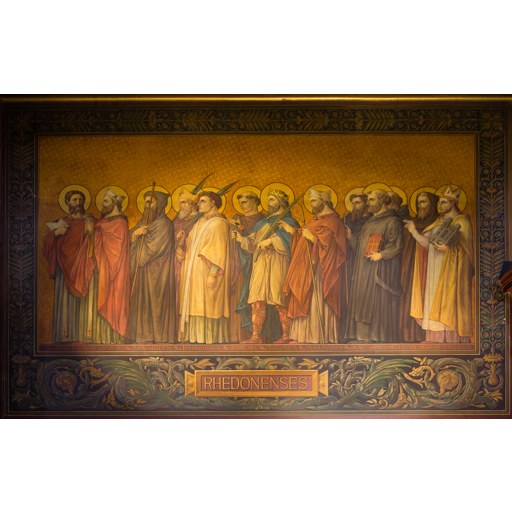
Alphonse Hénaff
License: Public domain
Conwoïon
Saint- Life Span
- d. 868
- Feast Day
- 5 January
- Gender
- male
- Church
- Catholic
Places
Roles & Family
Religious Information
Biography
Conwoïon (also spelled Conwoion or Convoyen) was a ninth-century Breton priest, monk, and abbot, remembered as the founder and first abbot of the Abbey of Saint-Sauveur at Redon. Later monastic tradition places his birth in the late eighth century at Comblessac, in the country of the Redones in eastern Brittany, and describes him as coming from a family of local nobility. Precise documentation of his childhood does not survive; what can be said with caution is that he received a clerical education in Brittany, was ordained to the priesthood, and in adulthood turned from the life of a secular cleric toward a more regular monastic observance. In the early 830s he gathered a small band of companions with the intention of living under a written rule in a new foundation.
In 832 Conwoïon established a monastery at Redon, at the confluence of the Oust and the Vilaine, on land obtained with the backing of Breton notables and of Nominoë, the missus of Brittany who later ruled as duke. The community took the Rule of Saint Benedict. The site lay in the diocese of Vannes, and the foundation at first met resistance from the local bishop, who contested the monks’ independence from episcopal control. Conwoïon therefore sought confirmation from the Carolingian court. Louis the Pious granted the house imperial protection and privileges, later renewed under Charles the Bald, which secured Redon’s status as an exempt Benedictine abbey. Donations of land and rights accumulated rapidly; the Cartulary of Redon, compiled from these acts, remains one of the principal sources for the society, law, and politics of ninth-century Brittany.
Conwoïon’s long abbacy unfolded against the rise of a distinct Breton principality under Nominoë, Erispoë, and Salomon, and against the growing danger of Scandinavian raids on the Armorican coasts and river valleys. Redon itself was exposed on the Vilaine. In the 860s Viking pressure forced the community to abandon the mother house for a time and to take refuge inland, at times under the protection of Duke Salomon. Despite these disruptions the abbey retained its estates and its identity as a Benedictine centre. Conwoïon died on 5 January 868, according to the date preserved in the Redon tradition, and was buried at the monastery he had founded.
A cult formed around his tomb at Saint-Sauveur de Redon. He was commemorated as a saint in Brittany, with his feast kept on 5 January. A Latin Life composed at Redon in later centuries, together with the cartulary, supplies most of what is known of him; many anecdotal details in the hagiography cannot be independently verified and should be treated as pious tradition rather than as contemporary report. What is historically secure is his role in implanting Benedictine monasticism in eastern Brittany and in creating a house whose archives illuminate the ninth-century Breton world. He was never the object of a medieval papal canonization in the later formal sense; his sanctity rested on local monastic cult and liturgical commemoration.