Crispin of Viterbo is a saint of the Catholic Church (1668 - 1750). Crispin of Viterbo's feast day is celebrated on 19 May.
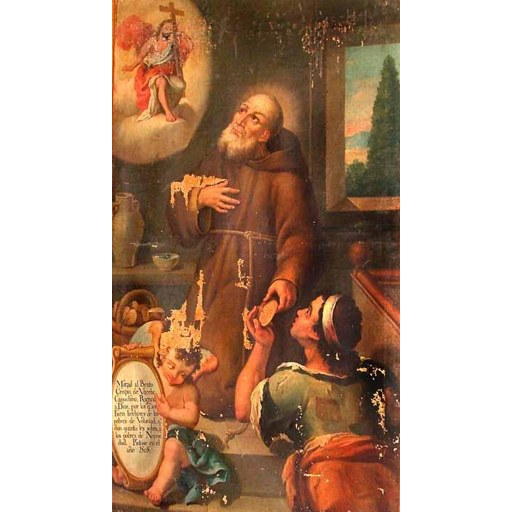
unknown painter
License: Public domain
Crispin of Viterbo
Saint- Life Span
- 1668 - 1750 (age 82)
- Feast Day
- 19 May
- Gender
- male
- Church
- Catholic
Places
Roles & Family
Religious Information
Canonization
Biography
Crispin of Viterbo was born Pietro Fioretti on 13 November 1668 in Viterbo, in the Papal States of central Italy, to a family of modest means. His father died while he was still a child, and he was raised by his mother in an atmosphere of simple Catholic piety. As a youth he was apprenticed to a shoemaker, a trade long associated with the early Christian martyrs Saints Crispin and Crispinian, whose name he would later take in religion. He frequented the Capuchin church in his native city and from an early age showed a marked attraction to the Franciscan life of poverty and hidden service.
In 1693, at about the age of twenty-five, he entered the Order of Friars Minor Capuchin as a lay brother and received the religious name Crispin. After his novitiate he was assigned to houses of the Roman Capuchin province and employed in the humble offices customary for a brother who was never ordained: cook, gardener, and questor (the friar charged with collecting alms). He served as cook at the convent of Tolfa and then spent a very long period, commonly described as several decades, as questor for the Capuchin community at Orvieto. There he became a familiar figure in the town and countryside, known for cheerfulness, practical charity to the poor, and a simple insistence on trust in divine providence.
During his lifetime he acquired a wide popular reputation for holiness. People of every rank, including clergy and prelates, sought him out for counsel, and numerous favors and healings were attributed to his prayers even before his death. He remained throughout a simple, unordained brother, continuing kitchen work, gardening, and the daily quest, and he never sought office or ordination. In later years he was transferred among Capuchin houses in the Roman region, including a final period in Rome itself. After illness he died in Rome on 19 May 1750, at the age of eighty-one.
Veneration began immediately after his death. Pope Pius VII beatified him on 7 September 1806. Pope John Paul II canonized him on 20 June 1982. The Catholic Church keeps his feast on 19 May, the anniversary of his death. He is remembered as an example of Franciscan humility and of sanctity lived in ordinary, hidden labor rather than in ecclesiastical rank.