Crispin is a saint of the Catholic Church. Crispin's feast day is celebrated on 25 October. Crispin is the patron saint of shoemakers;cobblers;leather workers;tanners;saddlers;lace-makers;weavers;Soissons.
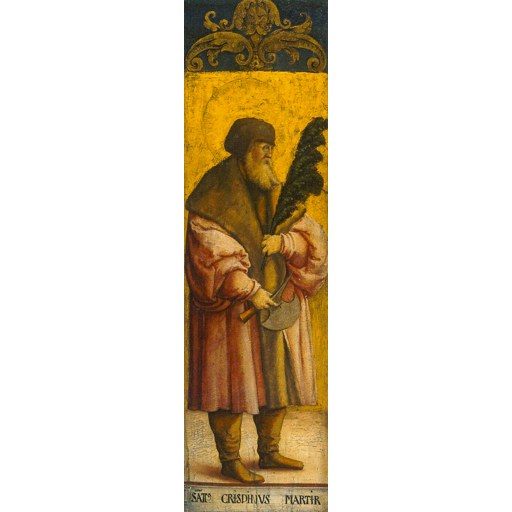
Master of Messkirch
License: Public domain
Crispin
Saint- Feast Day
- 25 October
- Gender
- male
- Church
- Catholic
Places
Roles & Family
Patronage
shoemakers;cobblers;leather workers;tanners;saddlers;lace-makers;weavers;Soissons
Biography
Saint Crispin, a Christian martyr of the third century, is customarily honored together with his brother Saint Crispinian. Almost everything that later ages claimed to know about him comes from Latin Acts of a legendary character, which medieval martyrologies and legendaries repeated as if they were history. In that tradition the two brothers were Romans of noble family who left the city during a time of hostility to Christians and settled at Soissons in Gaul. There they are said to have preached the Christian faith among the local population while earning their living as shoemakers. They worked at the trade by night so that they might teach by day, and they were remembered for furnishing shoes to the poor without charge. Whether or not any contemporary report underlies this picture, the artisan-missionary became the foundation of their later fame as patrons of cobblers and of all who work in leather.
The passion narrative follows a pattern familiar in Gallic hagiography. The brothers were denounced as Christians and brought before a prefect named Rictiovarus (also rendered Rictius Varus), a figure who appears in several similar texts and is not corroborated by independent Roman administrative evidence. After a series of tortures from which the legend claims they emerged unharmed, they were beheaded at Soissons. Traditional dates place the execution on 25 October in the mid-280s, most often 285 or 286, in the time of the emperor Maximian. Those years cannot be confirmed from non-hagiographical sources and fall well before the opening of the empire-wide persecution under Diocletian in 303. Modern historians therefore treat the detailed story as pious fiction constructed around an older local cult, while generally allowing that two martyrs of these names, or a pair of martyrs later so named, were honored at Soissons from a relatively early date.
Their bodies were said to have been buried at Soissons, where a basilica was afterwards raised over the tomb and an abbey under the dedication of Saint Crispin preserved relics through the Middle Ages. In the ninth century some relics attributed to them were translated to Osnabrück, which helped to spread the cult in northern Germany. The feast on 25 October entered the principal Western calendars and was long widely observed. Crispin and Crispinian became the chief patrons of shoemakers, cobblers, tanners, leather workers, and saddlers; lace-makers and weavers have also invoked them in certain districts, and Soissons itself regards them as local patrons. In English-speaking culture the day is inseparable from the speech before Agincourt in William Shakespeare's Henry V, which made Saint Crispin's Day a proverbial anniversary of shared courage. No trustworthy source records a wife, children, or membership in a religious order. Crispin was never Bishop of Rome and never held a patriarchal see. Like most martyrs of the age of persecutions, he was venerated as a saint by liturgical and popular acclaim long before the later process of papal canonization existed.
What can be affirmed with reasonable caution is therefore modest. An early Christian community at Soissons commemorated two martyrs on 25 October; a church and later an abbey stood over a burial place associated with them; and a legend formed by the early Middle Ages recast them as Roman brothers, shoemakers, and missionaries. From that legend European artisans took their heavenly patrons, and the feast acquired a literary afterlife far beyond the original Gallic shrine. The individual biography of Crispin himself, including the year of his birth and the exact year of his death, remains unknown.