Crispinian is a saint of the Catholic Church. Crispinian's feast day is celebrated on 25 October. Crispinian is the patron saint of shoemakers;cobblers;leather workers;tanners;saddlers;Soissons.
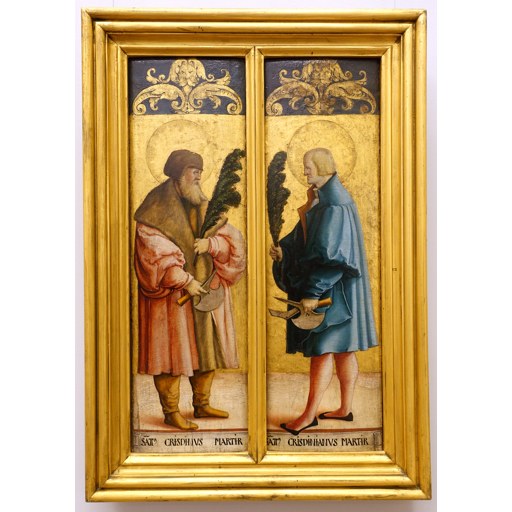
Daderot
License: Public domain
Crispinian
Saint- Feast Day
- 25 October
- Gender
- male
- Church
- Catholic
Places
Roles & Family
Patronage
shoemakers;cobblers;leather workers;tanners;saddlers;Soissons
Biography
Saint Crispinian is commemorated together with his brother Saint Crispin as a martyr of the Christian church in northern Gaul. The only substantial narrative of his life is a Latin passio of uncertain date, generally regarded by historians as a work of pious legend rather than a contemporary record. In that account the brothers belong to a noble family of Rome and leave Italy during a period of imperial persecution, taking up residence at Soissons in Belgic Gaul. There they earn their living as shoemakers, labouring by night in order to spend the day preaching the Gospel and relieving the poor, to whom they are said to have given shoes freely. No independent third-century source confirms their names, origin, or trade; what is historically secure is that a cult of Crispin and Crispinian was established at Soissons by late antiquity and that their names entered the early medieval martyrologies.
The passio sets their arrest in the time of the emperor Maximian and attributes their examination and torture to a prefect called Rictius Varus, a figure who also appears in other northern Gallic martyr stories and is not corroborated as a historical official. After a succession of torments the brothers are beheaded. Later medieval retellings multiply the miraculous elements of the interrogation. Traditional dates for the execution cluster around the mid-280s, commonly 285, 286, or 287, but these figures derive from the legend rather than from dated official acts, and they sit awkwardly with the chronology of Maximian’s reign and with the later Great Persecution under Diocletian. The Roman Martyrology, following the older Hieronymian tradition, simply places the martyrs at Soissons on 25 October without assigning a year.
Liturgical evidence for the cult is comparatively early. The Martyrologium Hieronymianum, whose material in large part reflects fifth- and sixth-century practice, records Crispin and Crispinian at Soissons on 25 October. A basilica dedicated to them existed in that city, and their tomb there became a focus of pilgrimage. During the Middle Ages relics attributed to the brothers were claimed by several churches; Osnabrück Cathedral in Saxony was among the more prominent of these later resting places, and other fragments were reported in Rome and elsewhere. In the medieval West the pair were adopted as patrons by guilds of cobblers, shoemakers, tanners, saddlers, and other leather workers, a patronage that followed directly from the shoemaking motif in their legend. English awareness of the feast was later reinforced by the St Crispin’s Day speech in Shakespeare’s history play Henry V, which treats 25 October as a day of national memory, though that literary fame attaches more to the date than to any additional biographical fact.
Crispinian is not known to have held episcopal, papal, or patriarchal office, nor is he associated with a religious order in the later canonical sense. The surviving tradition does not name a spouse or children. Like most martyrs of the pre-Constantinian period who entered the calendar through local veneration, he was not the object of a formal process of beatification or canonization of the kind developed in the later Middle Ages and after the Council of Trent; his status as a saint rests on ancient cult and reception into the martyrologies. Because the documentary base is so thin, a responsible account must distinguish the Soissons cult and the October feast, which are well attested from late antiquity onward, from the Roman origin, the cobbler’s bench, and the detailed passion, which remain the stuff of hagiographical tradition rather than of verifiable biography. In art and devotion he almost invariably appears with Crispin, the two brothers sharing a single feast, a single set of emblems (shoes, lasts, and occasionally palm and sword), and a single patronage of the leather trades.