Crispus of Chalcedon is a saint of the Catholic Church. Crispus of Chalcedon's feast day is celebrated on January 4.
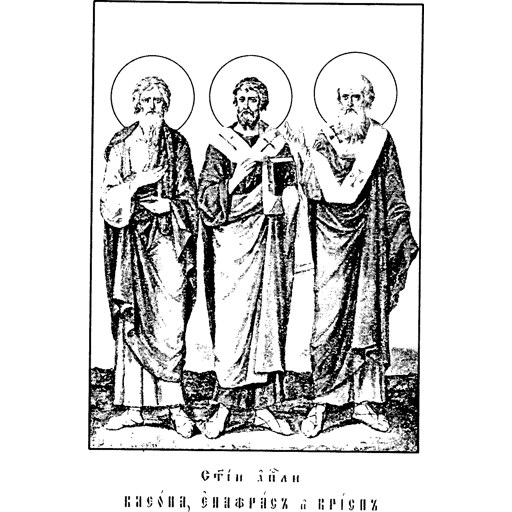
Unknown authorUnknown author
License: Public domain
Crispus of Chalcedon
Saint- Feast Day
- January 4
- Gender
- male
- Church
- Catholic
Roles & Family
Biography
Crispus of Chalcedon is numbered among the Seventy Apostles in the hagiographical and liturgical tradition of the Eastern Orthodox Church. Early Christian catalogues of the Seventy, including the list transmitted under the name of Hippolytus of Rome, identify him as bishop of Chalcedon, the ancient Bithynian city on the Asian shore of the Bosporus opposite Byzantium (the later Constantinople). Almost nothing about his life can be established from strictly contemporary first-century documents. The portrait that survives is therefore largely the product of later apostolic lists, menologia, and synaxaria rather than of independent historical narrative.
Eastern Christian tradition commonly identifies this bishop with the Crispus named in the New Testament. According to the Acts of the Apostles, Crispus, the ruler of the synagogue at Corinth, believed in the Lord together with his whole household during the Apostle Paul’s mission in Achaia. In the First Epistle to the Corinthians, Paul recalls that he himself baptized Crispus and Gaius. Later hagiographers held that this Corinthian convert became a companion of the apostles and was afterward appointed to the episcopal see of Chalcedon. Whether the synagogue ruler of Corinth and the bishop of Chalcedon are certainly the same person cannot be demonstrated from first-century sources, but the identification has been standard in Eastern menologia for many centuries.
The Church of Chalcedon would in later centuries become famous as the meeting place of the Fourth Ecumenical Council in 451, yet in the apostolic age it was a modest Christian community in the Roman province of Bithynia. No reliable account survives of Crispus’s episcopal acts, the length of his tenure, the manner of his death, or the place of his burial. He is not recorded as having held patriarchal rank, nor was he Bishop of Rome. No contemporary testimony documents a wife or children, and no ancient cult site or relic tradition can be verified with confidence. The historical Crispus, if the traditional identifications are accepted, belongs to the first Christian generation in Greece and Asia Minor; beyond that, the sources are silent.
In the liturgical calendar of the Eastern Orthodox Church, Crispus is commemorated on 4 January together with the rest of the Seventy Apostles. That synaxis is the principal and most securely attested feast associated with him as bishop of Chalcedon. In the Roman Martyrology, Saints Crispus and Gaius of Corinth are listed on 4 October, a Western commemoration that refers to the New Testament figures independently of the Chalcedonian episcopal tradition. No widely recognized patronages of places, professions, or causes are attached to his name, and he was never the subject of a formal papal canonization process of the later medieval or modern type.