Cunigunde of Luxembourg is a saint of the Catholic Church (d. 1040). Cunigunde of Luxembourg's feast day is celebrated on 3 March. Cunigunde of Luxembourg is the patron saint of Luxembourg;Lithuania;Bamberg;Archdiocese of Bamberg.
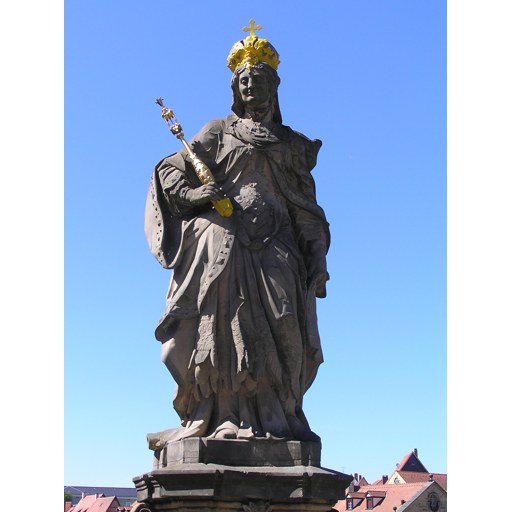
Mkleine
License: CC BY-SA 3.0
Cunigunde of Luxembourg
Saint- Life Span
- d. 1040
- Feast Day
- 3 March
- Gender
- female
- Church
- Catholic
Places
Relics & Where to Venerate
Location unknown
The bodily remains of Cunigunde of Luxembourg are a first-class relic. Venerated at Bamberg Cathedral.
Roles & Family
Religious Information
Patronage
Luxembourg;Lithuania;Bamberg;Archdiocese of Bamberg
Canonization
Biography
Cunigunde of Luxembourg was a daughter of Siegfried, Count of Luxembourg, and of Hedwig of Nordgau, and thus a member of one of the leading families of the western borderlands of the East Frankish or German kingdom. Her father had obtained the castle of Lucilinburhuc in the mid-tenth century, from which the dynasty took its name. Several of her brothers rose to high rank: Henry became Duke of Bavaria, Dietrich Bishop of Metz, and Adalbero Archbishop of Trier. No contemporary charter or chronicle records the year or the precise place of her birth; later tradition associates her with Luxembourg in the later tenth century. She was raised in an aristocratic culture that combined landed power, service to the Ottonian kings, and generous patronage of churches and monasteries.
Toward the end of the tenth century she married Henry, Duke of Bavaria, a great-grandson of King Henry I and a member of the Ottonian house. When the German princes elected Henry king in 1002, Cunigunde was crowned queen, and on 14 February 1014 Pope Benedict VIII crowned the pair emperor and empress in Rome. The marriage produced no children, a fact that brought the Ottonian dynasty to an end in the direct line and that later hagiographers explained by a supposed vow of perpetual virginity. A well-known legend, unattested in eleventh-century sources, relates that Cunigunde, accused of adultery, walked unharmed over red-hot ploughshares; historians regard the story as a later pious invention, while accepting the couple’s childlessness as historical. In government Cunigunde was an active partner. She appears repeatedly in royal diplomas as intercessor, she managed dower estates, and she supported Henry’s foundation of the Diocese of Bamberg in 1007, contributing property to the new see and its cathedral.
Henry II died on 13 July 1024. During the short interregnum Cunigunde, aided by her Luxembourg relatives, helped to preserve public order and to arrange the transfer of the imperial insignia to Conrad II after his election, thereby easing the passage of the crown from the Ottonians to the Salians. She then withdrew from political life. She and Henry had founded a Benedictine nunnery at Kaufungen in Hesse in 1017; the convent church was consecrated in 1025, and Cunigunde took the monastic habit there, according to later accounts laying her crown upon the altar. She lived thereafter as a nun under the Rule of Saint Benedict in the house she had endowed.
She died at Kaufungen on 3 March 1040 and was buried in Bamberg Cathedral beside her husband. Veneration at their tombs developed in the twelfth century. Henry II was canonized in 1146; Pope Innocent III canonized Cunigunde in 1200. Her feast day is 3 March. She is honoured as a patron saint of Luxembourg, of the city and Archdiocese of Bamberg, and of Lithuania. In Christian art she is often represented with a church model, alluding to her foundations, or with ploughshares, alluding to the later legend of her ordeal.