Cyril John Zohrabian is a venerable of the Catholic Church (1881 - 1972).
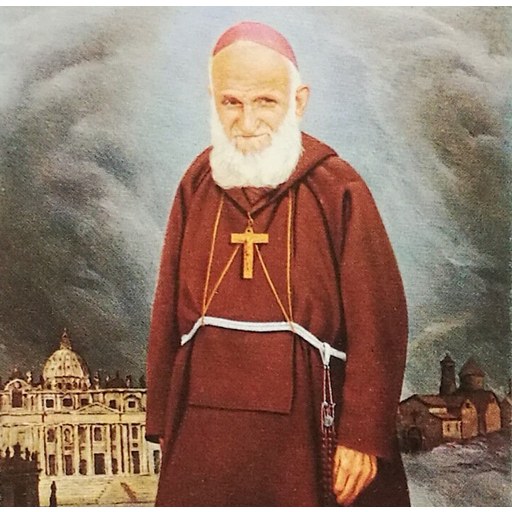
Duneir
License: CC BY-SA 4.0
Cyril John Zohrabian
Venerable- Life Span
- 1881 - 1972 (age 91)
- Gender
- male
- Church
- Catholic
Places
Roles & Family
Religious Information
Biography
Cyril John Zohrabian, known in Italian hierarchical sources as Cirillo Giovanni Zohrabian, was an Armenian Catholic bishop and a member of the Order of Friars Minor Capuchin. He was born in 1881 in Erzurum, called Karin by Armenians, a historic city of the Armenian highland then situated in the Erzurum Vilayet of the Ottoman Empire. Erzurum was home to Armenian Apostolic, Catholic, and Protestant communities, and the Armenian Catholic Church maintained an eparchial presence in the region. Zohrabian entered the Capuchin branch of the Franciscan family, taking Cyril as his religious name alongside his baptismal name John (Hovhannes or Giovanni). He was ordained a priest in 1904. His formation therefore combined the Latin religious life of the Capuchins with the identity of an Ottoman Armenian Catholic from the eastern provinces.
The world of his youth was destroyed in the following decade. During the First World War the Ottoman government carried out the Armenian Genocide, in the course of which the Armenian population of Erzurum and the surrounding highland was deported and largely annihilated, and Armenian Catholic clergy and institutions in eastern Anatolia were swept away with the rest. Widely available sources do not furnish a detailed personal chronicle of Zohrabian's movements in 1915 and the years immediately following, and it would be improper to invent episodes of imprisonment or escape. What can be said is that he survived, unlike many of his contemporaries among the Armenian Catholic clergy of Anatolia, and that his subsequent public career belongs to the Armenian Catholic diaspora and to the life of the Church in communion with Rome rather than to any reconstituted see in his native city.
In 1940, during the pontificate of Pius XII, he was named Titular Bishop of Acilisene. The titular see takes its name from Acilisene, the classical designation of the Armenian district of Ekeghiats in the Erzincan region, and so the title itself gestured toward the lost geography of Armenian Christianity in eastern Anatolia. He received episcopal consecration in October 1940 and held the titular see until his death. He did not become Patriarch of Cilicia of the Armenians, nor Bishop of Rome, and he was not a residential diocesan bishop of a living Armenian Catholic eparchy in the ordinary sense. His episcopate is best understood as that of a religious-order bishop serving the Holy See and the scattered Armenian Catholic faithful in the mid-twentieth century.
Zohrabian died in 1972 after more than thirty years as a bishop and at an advanced age. He has not been beatified or canonized, and he is not assigned a feast day or official patronages in the liturgical books of the Catholic Church. Notices of his life in standard hierarchical directories are short, and particulars such as the exact place of his death and burial are not securely established in commonly cited historical works. He remains a figure of interest for the history of the Armenian Catholic Church: a Capuchin from Erzurum whose lifespan reached from the last decades of Ottoman Armenian life, through the catastrophe of the First World War, into the postwar diaspora and the Roman orbit of an Eastern Catholic community rebuilding itself far from its historic homelands.