Cyril of Constantinople is a saint of the Catholic Church. Cyril of Constantinople's feast day is celebrated on 6 March.
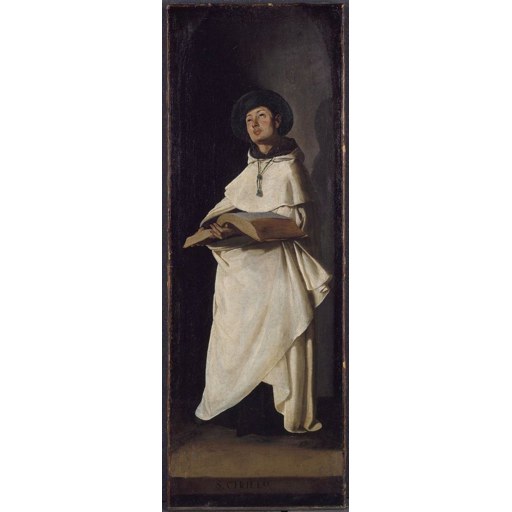
Zurbaran
License: Public domain
Cyril of Constantinople
Saint- Feast Day
- 6 March
- Gender
- male
- Church
- Catholic
Places
Roles & Family
Religious Information
Biography
Cyril of Constantinople is venerated in the Carmelite Order as a priest and early superior, traditionally counted among the first priors general of the hermits of Mount Carmel. The surviving portrait of his life depends almost entirely on Carmelite chronicles and catalogs compiled in the later Middle Ages, rather than on thirteenth-century archival records. Those later sources present him as a Greek Christian of Constantinople, formed in letters and theology, ordained to the priesthood in the Byzantine Church, and subsequently attracted to the eremitical community that had gathered on Mount Carmel in the Crusader Kingdom of Jerusalem. That community, living under the Formula of Life issued by Albert of Vercelli, Latin patriarch of Jerusalem, in the first years of the thirteenth century, was then in the process of becoming the Order of the Brothers of the Blessed Virgin Mary of Mount Carmel.
According to the same tradition, Cyril was elected prior general in the early 1230s, often dated about 1231 or 1232, and was listed as third in succession after the order’s legendary first superiors. Writers of the order ascribed to him letters and a treatment of the procession of the Holy Spirit, a subject that would have suited a Greek priest living among Latins in the decades after the Fourth Crusade and the Latin occupation of Constantinople. Traditional notices place his death about 1234 or 1235. The Carmelites observed his feast on 6 March, honoring him as a confessor. No reliable contemporary source records the place of his death or burial, though if the traditional chronology were accepted he would have died while the principal house of the order still lay on Mount Carmel, before the later withdrawal of many friars to Europe under pressure from the Mamluk advance in the Holy Land.
Modern historical criticism has not been able to confirm this biography. Documentation for the internal government of the Carmelites before their expansion in the West is fragmentary. Scholars, including the Bollandists and Carmelite historians of the twentieth century, have observed that medieval lists of early priors general mix names that can be corroborated with others that appear only in later, often legendary, narratives constructed to give the order an ancient and illustrious past. Cyril’s birth date is unknown; figures sometimes circulated in popular notices have no documentary foundation. It remains possible that a Greek cleric of that name was associated with Carmel, but it is equally possible that the saint as commemorated is a composite or a pious elaboration. He was never the subject of a well-documented papal canonization, and his cult remained essentially an order devotion rather than a widely diffused popular cult of the universal Church.
Cyril of Constantinople is not to be confused with the great patristic bishops Cyril of Jerusalem and Cyril of Alexandria, nor with the Orthodox patriarchs of Constantinople who later bore the name, such as Cyril I Lucaris in the seventeenth century. He held neither the papacy nor a patriarchal see. As a Carmelite he is presumed to have lived in celibacy, and no spouse or children are recorded. Specific patronages of places, trades, or causes are not securely attached to his name in the wider Church. What the tradition preserves is the Carmelites’ memory of a learned Greek priest who, in their telling, linked the world of Constantinople with the hermits of Mount Carmel and helped govern the order in its earliest, still obscure, generation.