David of Gareji is a venerable of the Catholic Church. David of Gareji's feast day is celebrated on Thursday after Ascension; 7 May.
Certain types of Egyptian works (official documents, stamps, works of national folklore) should use specific license tags instead of this generic tag.
License: Public domain
David of Gareji
Venerable- Feast Day
- Thursday after Ascension; 7 May
- Gender
- male
- Church
- Catholic
Places
Roles & Family
Biography
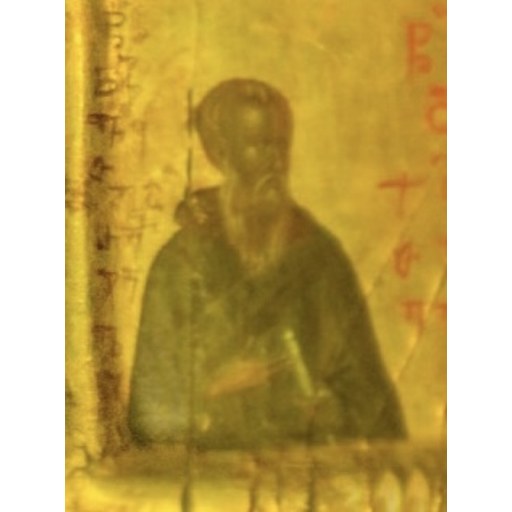
David of Gareji, known in Georgian as Davit Garejeli, was a sixth-century Christian monk numbered among the Thirteen Assyrian Fathers, a group of missionaries traditionally said to have come from Syria or Mesopotamia to the kingdom of Iberia (eastern Georgia) in order to strengthen monastic life and Christian practice. Medieval Georgian tradition presents them as disciples of John of Zedazeni, who assigned each companion to a different district. David is associated with the arid Gareja country on the outer slopes of the Iori plateau in Kakheti, a landscape of caves and semi-desert that later took his name. Contemporary sixth-century documentation for his life is lacking; what is known comes chiefly from later Georgian hagiography, liturgical commemoration, and the long history of the monastery that claims him as founder.
According to the Georgian Life of David of Gareji, he settled in the wilderness with a disciple named Lucian (Lukiane) and lived as a hermit, subsisting on plants and on the milk of wild deer. He is credited with founding the lavra that became the core of the David Gareja monastic complex, a network of rock-cut churches and cells that in subsequent centuries grew into one of the principal centers of Georgian monasticism, manuscript production, and wall painting. Hagiographical narratives also attach to him a disciple or companion named Dodo, associated with a neighboring monastery in the same desert. The vitae describe a life of extreme asceticism, miracles of provision in the desert, and conflicts with local hunters or landowners who at first opposed the monks' occupation of the wilderness.
A well-known episode in the tradition recounts a pilgrimage toward Jerusalem. Feeling himself unworthy to enter the holy city, David is said to have taken only three stones from its vicinity as a blessing. In the story, the patriarch of Jerusalem was warned in a vision that the grace of Jerusalem was departing with the stranger, and messengers recovered two of the stones, leaving David with one. That stone was later venerated at the Gareja lavra as a wonder-working relic. Another cycle of stories, of a type common in monastic literature, tells of a false accusation of sexual misconduct against the saint, disproved by a miraculous testimony, after which David withdrew still further into the desert. These accounts cannot be verified as historical events; they belong to the medieval portrait of the saint as a wonder-worker and model of humility.
David is believed to have died in the Gareja wilderness in the sixth century and to have been buried at his monastery. His tomb and the cave churches of the lavra became a major pilgrimage site in Georgia. The David Gareja complex continued to expand under later kings and abbots, suffered destruction in invasions (notably a Persian massacre of monks in the early seventeenth century), and remains an important holy place of the Georgian Orthodox Church, though part of the Udabno monastery lies on the modern Georgian-Azerbaijani border. David is commemorated in the Georgian church on the Thursday after the Feast of the Ascension and, together with the other Assyrian Fathers, on 7 May. He was never a bishop, patriarch, or pope; his authority was that of a desert abbot and spiritual father. Precise years of birth and death, a birthplace more specific than the Syrian or Mesopotamian origin of his group, and any record of marriage or children are not preserved in reliable historical sources.