Deacon Titus is a saint of the Catholic Church.
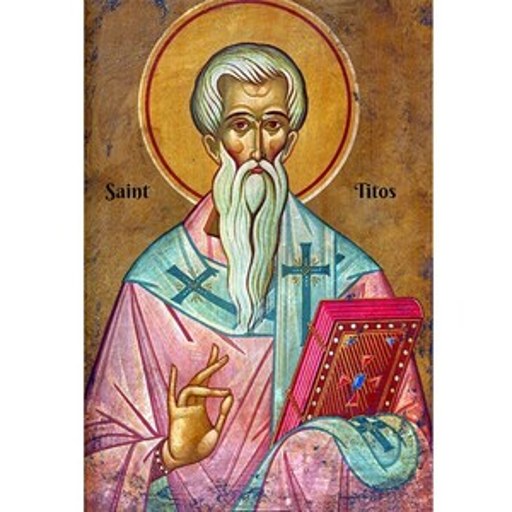
https://www.etsy.com/listing/1532974710/saint-titus-saint-titos-prayer-icon
License: unknown
Deacon Titus
Saint- Gender
- male
- Church
- Catholic
Roles & Family
Biography
The figure designated "Deacon Titus" cannot be identified with certainty from the major historical and hagiographical sources of the Christian tradition. The name Titus itself is well attested in the New Testament as that of a Gentile co-worker of the Apostle Paul. In the Epistle to the Galatians, Paul notes that Titus, a Greek, was not compelled to be circumcised when they went up to Jerusalem. In the Second Epistle to the Corinthians, Titus appears as a trusted messenger who brought news of the Corinthian church's repentance and who later returned to complete the collection for the saints in Jerusalem. The Pastoral Epistle addressed to Titus presents him as having been left in Crete to set in order what remained and to appoint elders in every town. Later patristic writers, including Eusebius of Caesarea in the fourth century, and subsequent Cretan tradition, regard this Titus as the first bishop of Crete, with his see at Gortyna. He is commemorated as a saint in both East and West, yet the sources uniformly describe him as an apostolic man and bishop, not as a deacon.
No entry in the Roman Martyrology, the Byzantine Menaia, the Coptic Synaxarium, or the principal collections of the Bollandists isolates a distinct "Deacon Titus" whose life, martyrdom, or cult can be independently verified. The seven deacons chosen in Acts 6 are named as Stephen, Philip, Prochorus, Nicanor, Timon, Parmenas, and Nicolaus; Titus is not among them. Occasional local calendars or later legendary accounts may mention clergy named Titus who served in the diaconate, but these notices lack the chronological, geographical, or documentary anchors required for historical reconstruction.
A separate fourth-century churchman named Titus of Bostra, bishop of that Arabian see, composed a lengthy refutation of Manichaeism that survives in Greek and Syriac. He too was a bishop, not a deacon, and his career belongs to the post-Constantinian episcopate. Other bearers of the name appear as martyrs or confessors in regional lists, yet none is regularly styled "Deacon Titus" with an accompanying, source-based biography.
Because the subject cannot be matched to a documented individual, no year of birth, year of death, place of origin, place of burial, feast day, or list of patronages can be supplied from reliable evidence. The fields that remain empty in the accompanying record reflect that absence of verification rather than an oversight. Any more precise identification would require additional data such as a diocese, a century, a martyrdom account, or a liturgical commemoration that is not provided.