Deacons Timothy is a saint of the Catholic Church. Deacons Timothy's feast day is celebrated on 3 May.
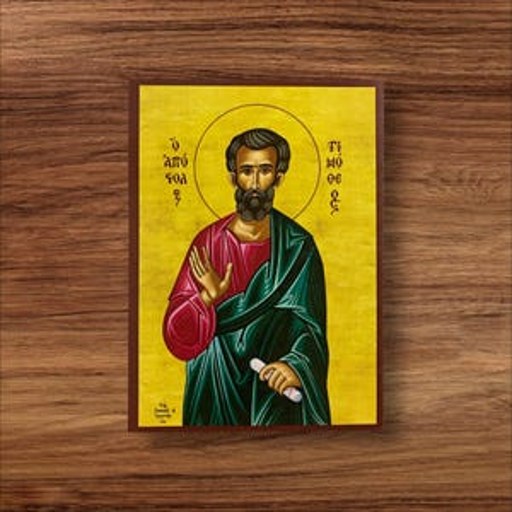
https://www.etsy.com/uk/listing/1865562280/orthodox-icon-of-saint-apostle-timothy
License: unknown
Deacons Timothy
Saint- Feast Day
- 3 May
- Gender
- male
- Church
- Catholic
Places
Roles & Family
Religious Information
Biography
Saint Timothy, commemorated jointly with his wife Maura (also rendered Mavra), is a Christian martyr of the Thebaid in Roman Egypt. In Coptic tradition and in a number of Orthodox synaxaria he is styled a deacon; in the Greek martyr acts and in several Latin notices he is called a reader or lector, that is, a minor cleric entrusted with the public reading of Scripture. The couple is linked to the village of Penapeia (the name appears with variant spellings such as Penapeis or Perapeis) in the neighbourhood of Antinoe in Upper Egypt. Tradition holds that they had been married only twenty days at the time of their arrest, and no children are mentioned in the accounts.
The passion narrative, which survives in Greek and in Oriental versions, places their trial before the governor Arianus during the reign of Diocletian. Timothy was ordered to produce the liturgical books of his church so that they might be destroyed. He refused to betray them. The Acts then describe a succession of tortures: he was suspended, weights were applied, and heated irons were used. The governor next summoned the young wife, expecting that she would weaken her husband's resolve. Maura instead declared herself a Christian. She is said to have suffered the tearing out of her hair and the cutting of her fingers before both were sentenced to death.
Husband and wife were crucified, or fastened to crosses, facing one another. The legend reports that they remained alive for nine days, conversing and encouraging each other, and that they died on the crosses. Historians of hagiography treat much of this dialogue and some of the more theatrical cruelties as later literary development, of a kind common in the cycles of Theban martyrs in which Arianus repeatedly figures as persecutor. What the liturgical tradition preserves is the memory of a minor cleric named Timothy and his wife Maura who were put to death in the Thebaid for refusing to surrender the Scriptures or to sacrifice to the gods, in the last great pagan persecution of the Roman Empire.
The Roman Martyrology records them on 3 May, and the Byzantine Menaion keeps the same date. They are also entered in Coptic synaxaria, which helps explain why some churches remember Timothy specifically as a deacon. No papal act of canonization or beatification is attached to them; they belong to the ancient, pre-congregational saints whose cult grew from local liturgical commemoration. A precise year of birth is unknown. Many popular martyrologies print 286 as the year of death, but that figure is traditional rather than independently documented, and the historical setting is simply the Diocletianic persecution in Egypt. They have no well-established list of patronages in the major Western or Eastern directories of saints.