Deicola is a saint of the Catholic Church (d. 625). Deicola's feast day is celebrated on 18 January. Deicola is the patron saint of Lure.
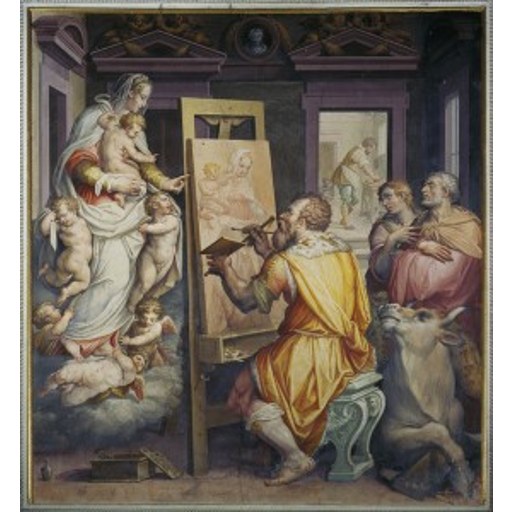
http://www.italianrenaissanceresources.com/units/unit-1/essays/saint-luke-paints-the-virgin-and-child-genealogy-of-an-image/
License: unknown
Deicola
Saint- Life Span
- d. 625
- Feast Day
- 18 January
- Gender
- male
- Church
- Catholic
Places
Roles & Family
Religious Information
Patronage
Lure
Biography
Saint Deicolus (also known as Deicola, Desle, Dichul, Deel, Deille, Delle, and Dicuil) was an Irish monk and missionary of the late sixth and early seventh centuries, remembered as a companion of Saint Columbanus and as the founder of the monastery of Lure in eastern Gaul. Tradition places his origin in the province of Leinster in Ireland. Later medieval writers, followed by some modern hagiographical compilations, identified him as the elder brother of Saint Gall, another disciple of Columbanus, but that kinship is not firmly attested in early independent sources and remains uncertain. He belonged to the generation of Irish peregrini who left their homeland to live in voluntary exile for Christ on the Continent, and he is associated with the austere Irish monastic tradition that Columbanus carried from Bangor into the Frankish kingdoms.
Deicolus accompanied Columbanus when the latter departed Ireland for Gaul, a journey usually placed around 590. The Irish monks first settled at Annegray in the Vosges and then established the monastery of Luxeuil, which became a major centre of Columbanian monasticism. Deicolus lived there under the Rule of Columbanus. When political conflict with King Theuderic II of Burgundy and the dowager Brunhilda led to Columbanus’s expulsion from Luxeuil around 610, many of the Irish monks followed their abbot into exile. Deicolus, described in his later Life as already advanced in age and too weak to continue the journey, remained behind in the region.
According to the tenth-century Vita Sancti Deicoli, written at Lure itself and therefore a late and partly legendary source, the aged monk wandered into the forested country of the southern Vosges. A frequently repeated story relates that, exhausted and thirsty, he planted his staff in the ground and a spring of water appeared; another episode tells of a wild animal that indicated the site of his future hermitage. There he built a cell at a place called Lutra, later Lure, in what is now the département of Haute-Saône in Franche-Comté. Disciples gathered around him and the hermitage grew into a monastery. Royal favour followed: King Clothar II of Neustria is said to have granted lands and protection after an encounter with the saint, thereby securing the material foundation of the house.
Deicolus is traditionally held to have died at Lure on 18 January 625 and to have been buried at the monastery he founded. Because the principal narrative of his life was composed some three centuries after his death, many anecdotal and miraculous details cannot be verified independently, but his role as a Columbanian pioneer in the region of Lure and the early existence of that monastery are consistent with the broader history of Irish monastic foundations in seventh-century Burgundy and Austrasia. His feast is kept on 18 January.
The Abbey of Lure became an important Benedictine community in later centuries and eventually a princely abbey of the Holy Roman Empire; the cult of its founder was maintained there and his relics were venerated. The town of Lure grew around the monastic precinct. In French he is commonly known as Saint Desle. After the upheavals of the early modern period and the French Revolution, his memory has remained attached to the locality, of which he is regarded as patron, and 18 January continues as his principal liturgical commemoration.