Deiniol is a saint of the Catholic Church (d. 584). Deiniol's feast day is celebrated on 11 September. Deiniol is the patron saint of Bangor;Diocese of Bangor.
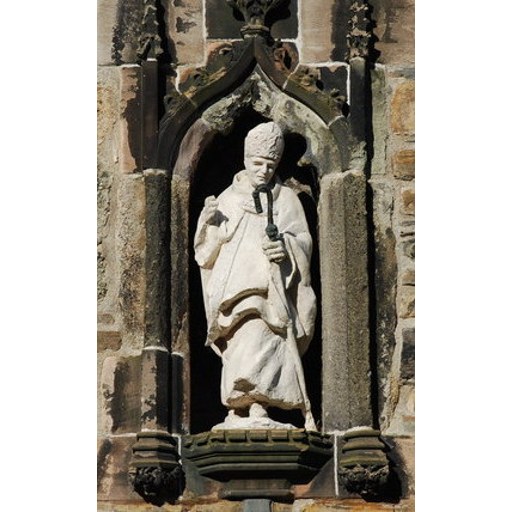
Alan Fryer
License: CC BY-SA 2.0
Deiniol
Saint- Life Span
- d. 584
- Feast Day
- 11 September
- Gender
- male
- Church
- Catholic
Places
Sacred Place

Roles & Family
Patronage
Bangor;Diocese of Bangor
Biography
Saint Deiniol, known in Latin as Daniel and in later Welsh tradition as Deiniol Wyn (Deiniol the Blessed), was a sixth-century British churchman venerated as the first bishop of Bangor in the kingdom of Gwynedd in north Wales. He is remembered above all as the founder of the monastery of Bangor Fawr on the Menai Strait, a community whose wattled enclosure (bangor) gave its name to the later cathedral city. The chief early historical notice of him is the entry in the Annales Cambriae recording the death of Daniel of the Bangors under the year 584. No contemporary Life survives, and almost every narrative detail beyond that annalistic notice depends on medieval genealogies and much later hagiography.
Welsh genealogical tracts, especially the Bonedd y Saint, present Deiniol as a son of Dunod Fawr ap Pabo Post Prydain, thereby attaching him to a northern British dynasty of the Hen Ogledd (the Old North). Some versions name his mother as Dwywai ferch Lleenog. These pedigrees were compiled centuries after his lifetime and cannot be independently verified, but they show a consistent medieval belief that he belonged to a high-status British kindred that had moved or extended its influence into Wales. His father Dunod is often associated with the important monastery of Bangor Is-y-coed (Bangor-on-Dee) in Maelor. Some later writers also credit Deiniol himself with a share in that foundation; modern historians more commonly distinguish Bangor Fawr in Gwynedd as Deiniol’s own house and treat Bangor-on-Dee as a related but separate community, later famous from Bede’s account of the slaughter of its monks in the early seventh century.
Later hagiographical narrative makes Deiniol a contemporary of Saint David and of other leading figures of the sixth-century British church. He is said to have attended the Synod of Brefi in Ceredigion, the gathering at which David’s preaching was remembered as decisive, and some accounts claim that he received episcopal consecration from David or from Dyfrig. King Maelgwn Gwynedd is traditionally named as the royal patron who granted land for the Bangor monastery, although the dates usually assigned to Maelgwn sit uncomfortably with a death in 584, a reminder that early medieval Welsh chronology is uncertain. As abbot-bishop, Deiniol stood in the Celtic monastic pattern of leadership, in which a major monastery served as mother church of a surrounding district that in time became the diocese of Bangor.
Deiniol’s cult was established in north Wales by the early Middle Ages and remained centred on Bangor, where the medieval and modern cathedral is dedicated to him. His feast is kept on 11 September in Welsh calendars. Churches under his invocation are found in Gwynedd and elsewhere in Wales, among them the church at Hawarden in Flintshire. He is regarded as the patron saint of Bangor and of its diocese. The see that bears his name continued as one of the ancient Welsh bishoprics through the Middle Ages and after the Reformation. Because the sources are late and often legendary, the historical Deiniol can be affirmed with confidence only as a sixth-century monastic founder and bishop whose death was recorded in 584 and whose name stayed attached to the church of Bangor.