Denis de Glouchitsa is a venerable of the Catholic Church (d. 1437). Denis de Glouchitsa's feast day is celebrated on 1 June.
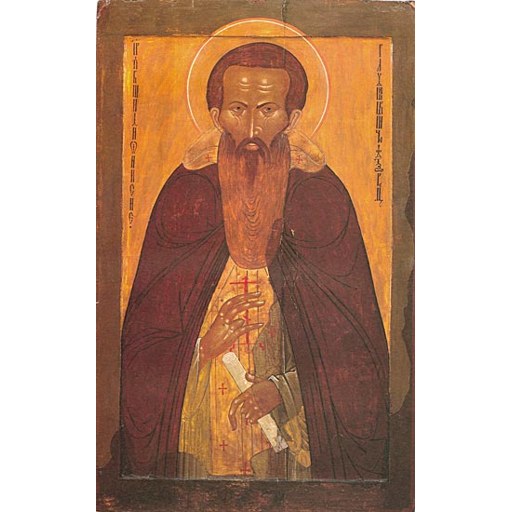
Unknown authorUnknown author
License: Public domain
Denis de Glouchitsa
Venerable- Life Span
- d. 1437
- Feast Day
- 1 June
- Gender
- male
- Church
- Catholic
Places
Roles & Family
Canonization
Biography
Saint Dionysius of Glushitsa, known in French as Denis de Glouchitsa and in Russian as Dionisy Glushitsky, was a monk, abbot, monastery founder, and icon painter of the Russian North in the late fourteenth and early fifteenth centuries. He was born in the Vologda region; surviving medieval sources do not record a precise birthplace or his name in the world. Traditional accounts sometimes place his birth in the 1360s, but that figure is not independently documented and should be treated as approximate. In his youth he entered the Spaso-Kamenny Monastery of the Saviour, on a rocky island in Lake Kubenskoye, then a leading monastic house of the northern Russian lands. He received the monastic tonsure there from Abbot Dionysius, later Archbishop of Rostov. After years of obedience in that community he sought a more hidden eremitical life and, with his abbot’s blessing, withdrew into the forests along the Glushitsa River.
In the early fifteenth century he established a monastery dedicated to the Protection of the Most Holy Theotokos (Pokrov) on the Glushitsa. Disciples gathered, the hermitage became a cenobium, and he served as its abbot. When the community grew large he founded a second house nearby at Sosnovets, dedicated to Saint John the Baptist, for monks who desired a stricter solitude, and he himself settled there. These foundations belong to the monastic colonization of the Russian North—the so-called Northern Thebaid—in the generations after Saint Sergius of Radonezh. Dionysius was remembered for humility, prolonged fasting, night vigils, manual labour, and the spiritual counsel he gave to monks and lay visitors.
He was also a skilled iconographer and artisan. Tradition ascribes to him many icons painted for churches in the Vologda country, including images of the Mother of God and an icon of Saint Cyril of Belozersk said to have been executed from life. He copied liturgical and spiritual books, carved wooden liturgical vessels and crosses, and trained disciples in these crafts. The principal written source for his career is a Life composed in the fifteenth century by his disciple, the hieromonk Irinarch. Dionysius died on 1 June 1437 and was buried at the Glushitsa monastic complex. His relics were later described as incorrupt, and local veneration arose soon after his repose.
He was numbered among the saints of the Russian Church at the Moscow Council of 1547, convened under Metropolitan Macarius of Moscow, which glorified a large group of locally venerated Russian ascetics. His feast is kept on 1 June, and he is also commemorated in the Synaxis of the Saints of Vologda. He held no episcopal, patriarchal, or papal office. The sources present him as a celibate monk from his youth and do not record a marriage or children. No official list of patronages in the Western sense is attached to his cult; he is honoured in Orthodox memory as a founder of northern Russian monasticism and as an icon painter.