Denis is a saint of the Pre-Schism (Universal) Church. Denis's feast day is celebrated on 9 October. Denis is the patron saint of France;Paris;against headaches;against rabies;against hydrophobia;against frenzy;against strife;possessed people;against demonic possession.
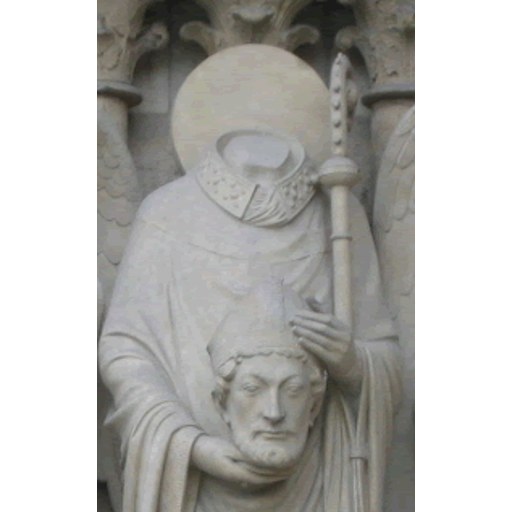
Original author Urban
License: Public domain
Denis
Saint- Feast Day
- 9 October
- Gender
- male
- Church
- Pre-Schism (Universal)
Places


Relics & Where to Venerate
Location unknown
The bodily remains of Denis of Paris are a first-class relic. Venerated at Basilica of Saint-Denis.
Roles & Family
Patronage
France;Paris;against headaches;against rabies;against hydrophobia;against frenzy;against strife;possessed people;against demonic possession
Biography
Saint Denis, also known as Dionysius or Denys of Paris, was a third-century Christian missionary who became the first bishop of Paris and is venerated as a martyr and as a principal patron of France. The earliest substantial account of his life is given by Gregory of Tours in the sixth century. According to Gregory, Denis was one of seven bishops dispatched from Rome to Gaul during the reign of the emperor Decius (249-251) in order to restore and organize the Church after a period of persecution. The others named in that tradition include Gatianus of Tours, Trophimus of Arles, Paul of Narbonne, Saturninus of Toulouse, Stremonius of Auvergne, and Martial of Limoges. Denis was assigned to the city of the Parisii, then known as Lutetia, where he is said to have established a Christian community on an island in the River Seine, customarily identified with the Île de la Cité, and to have served as its bishop.
With two companions, the priest Rusticus and the deacon Eleutherius, Denis preached in and around Lutetia and is credited with numerous conversions. Their activity aroused hostility from local authorities or from the pagan population. The three men were arrested, imprisoned, and put to death by beheading. Tradition locates the execution on the hill north of the city later called Montmartre, a name often interpreted as referring to the martyrs, though other etymologies have been proposed. The exact year of the martyrdom cannot be established with certainty. It is commonly placed in the middle of the third century, often in connection with the Decian persecution or with later measures under Valerian, but the surviving sources do not yield a precise date, and later martyrologies have offered more than one conventional year.
A well-known medieval legend, fully developed by the early Middle Ages, presents Denis as a cephalophore. After his beheading he is said to have taken up his own head and to have walked a considerable distance, continuing to preach, until he reached the spot where he wished to be buried. A shrine arose at that site, a few miles north of Paris. In the seventh century King Dagobert I founded or richly endowed a monastery there, which became the royal Abbey of Saint-Denis. The abbey church, later rebuilt as an early masterpiece of Gothic architecture under Abbot Suger in the twelfth century, served for centuries as the burial place of the kings of France. Relics attributed to Denis, Rusticus, and Eleutherius have long been associated with the basilica that stands on the site.
Medieval writers further identified Denis of Paris with Dionysius the Areopagite, the Athenian convert of the apostle Paul mentioned in the Acts of the Apostles, and with the anonymous fifth- or sixth-century author of the theological works known as the Corpus Dionysiacum. This triple identification was advanced in the ninth century by Hilduin, abbot of Saint-Denis, and was widely accepted in the Latin West, notably in the circle of Abbot Suger. Modern historical scholarship rejects the identification: Denis of Paris was a third-century missionary bishop in Gaul, distinct both from the first-century Areopagite and from the later Christian Neoplatonist writer. The conflation nonetheless shaped liturgy, art, and royal ideology for centuries.
Denis has been honored as a saint from an early date, without a formal process of canonization of the later medieval type. His principal feast in the Roman Catholic Church falls on 9 October. He is invoked as patron of France and of Paris, and against headaches, rabies, frenzy, strife, and demonic possession. The oriflamme, the battle standard of the French kings, was kept at the Abbey of Saint-Denis and associated with his cult. His legend and shrine played a central role in the religious and royal ideology of medieval France, and the basilica that bears his name remains one of the principal monuments of French Christian history.